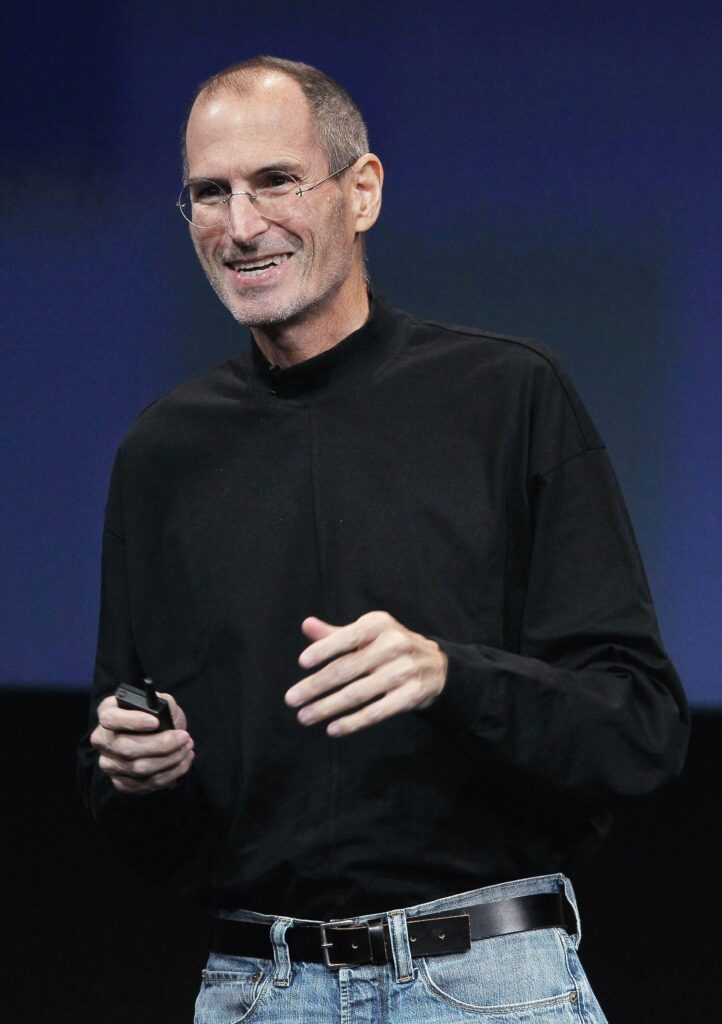
Steve Jobs (1955–2011) was an American entrepreneur and cofounder of Apple Inc. A visionary leader, he revolutionized personal computing, music, phones, and animation with products like the Macintosh, iPod, iPhone, and iPad, blending technology with design and innovation.
Introduction :
Steve Jobs was one of the most influential innovators of the modern era, a visionary whose ideas reshaped multiple industries, including personal computing, animation, music, telecommunications, and digital publishing. As the co-founder of Apple Inc., Jobs transformed how people interact with technology, emphasizing simplicity, elegance, and user experience. His life story is not merely one of technological achievement but also of creativity, resilience, rebellion, failure, and redemption. From his humble beginnings as an adopted child to becoming a global icon of innovation, Steve Jobs’ biography is a compelling narrative of passion and perseverance.
Early Life and Adoption (1955–1969)
Steven Paul Jobs was born on February 24, 1955, in San Francisco, California. His biological parents were Joanne Schieble, a graduate student, and Abdulfattah Jandali, a Syrian-born political science professor. Due to cultural and familial pressures, particularly Joanne’s father’s disapproval of the relationship, the couple decided to place their child for adoption.
Jobs was adopted by Paul Reinhold Jobs and Clara Hagopian Jobs, a working-class couple living in Mountain View, California. Paul Jobs was a machinist and Coast Guard veteran, while Clara worked as an accountant. They named him Steven Paul Jobs.
From an early age, Jobs knew he was adopted, a fact his parents never concealed. Clara repeatedly told him he was “chosen,” a concept that deeply influenced his sense of destiny and individuality. Jobs later described his adoptive parents as his “real parents” and rejected the idea that he had been abandoned.
Growing up in Silicon Valley—then an emerging hub for electronics and engineering—Jobs was exposed early to technology. His father taught him how to work with tools and electronics in the family garage, instilling a love for craftsmanship and precision. Paul Jobs emphasized that even unseen parts of a product should be well made, a philosophy that would later define Apple’s approach to design.
Education and Early Influences (1969–1974)
Jobs attended Homestead High School in Cupertino, California. He was an intelligent but often rebellious student who became bored with traditional education. Teachers found him challenging, as he frequently questioned authority and rules.
During high school, Jobs met Steve Wozniak, a brilliant engineer five years his senior. Their friendship was pivotal. While Wozniak was shy and technically gifted, Jobs was charismatic, ambitious, and visionary. Together, they bonded over electronics, pranks, and a shared fascination with technology.
One of their earliest collaborations was the creation of “blue boxes,” illegal devices that allowed users to make free long-distance phone calls by manipulating telephone tones. Jobs handled marketing and sales, while Wozniak engineered the device. The venture was illegal, but it taught Jobs valuable lessons about teamwork, entrepreneurship, and the power of technology.
After graduating from high school in 1972, Jobs enrolled at Reed College in Portland, Oregon. However, he dropped out after just six months, unwilling to spend his parents’ money on an education he found uninspiring. Despite dropping out, Jobs continued auditing classes that interested him, including a calligraphy course. This seemingly minor decision later had a profound impact on Apple, influencing the typography and visual elegance of the Macintosh.
Spiritual Exploration and India (1974–1975)
After leaving college, Jobs embarked on a period of spiritual exploration. In 1974, he traveled to India with his friend Daniel Kottke, seeking enlightenment and deeper meaning in life. He visited ashrams and immersed himself in Eastern philosophies, particularly Zen Buddhism.
Although he did not find the spiritual awakening he sought, the journey profoundly shaped Jobs’ worldview. He adopted a minimalist lifestyle, practiced meditation, and embraced intuition as a guiding force. These influences later manifested in Apple’s design philosophy: simplicity, focus, and clarity.
Upon returning to California, Jobs worked at Atari as a video game designer. Known for his intensity and unconventional behavior, he negotiated creative ways to complete projects, often enlisting Wozniak to help while keeping a portion of the payment for himself. Though controversial, these experiences sharpened his negotiating skills and reinforced his belief in creative problem-solving.
The Founding of Apple (1976)
In 1976, Steve Jobs, Steve Wozniak, and Ronald Wayne founded Apple Computer Company. The trio began working out of the Jobs family garage in Los Altos, California. Wozniak designed the Apple I, a simple computer motherboard, while Jobs envisioned its commercial potential.
Unlike other hobbyist computers of the era, the Apple I was sold fully assembled, making it accessible to non-technical users. Jobs persuaded local electronics retailer Paul Terrell to purchase 50 units, providing crucial early funding.
Ronald Wayne soon sold his shares for a modest sum, leaving Jobs and Wozniak as primary partners. In 1977, Apple introduced the Apple II, a groundbreaking personal computer with color graphics and an open architecture. It became a massive commercial success, establishing Apple as a major player in the emerging personal computer industry.
At just 21 years old, Jobs became a millionaire. However, wealth did not change his intense personality. He demanded perfection from employees, often clashing with colleagues. Despite his difficult temperament, his ability to envision the future and inspire others was undeniable.
The Macintosh and Rise to Fame (1979–1984)
In 1979, Jobs visited Xerox PARC (Palo Alto Research Center), where he saw the graphical user interface (GUI), including windows, icons, and a mouse. Recognizing its revolutionary potential, Jobs pushed Apple to develop a computer based on these ideas.
This vision culminated in the Macintosh, introduced in 1984. The product was launched with one of the most iconic commercials in advertising history, directed by Ridley Scott and aired during the Super Bowl. The ad positioned Apple as a rebellious force against conformity.
The Macintosh was praised for its user-friendly interface and design, but early models were limited by memory and high cost. Internally, Jobs’ management style caused friction. He often berated employees, set unrealistic deadlines, and created a culture of fear and excellence simultaneously.
Despite these challenges, Jobs became a public symbol of innovation. His black turtleneck, jeans, and intense stage presence became iconic. However, tensions within Apple’s leadership were escalating.
Conflict and Departure from Apple (1985)
As Apple grew, Jobs’ role became more complicated. In 1983, Apple hired John Sculley, a former Pepsi executive, as CEO. Jobs famously convinced him to join by asking, “Do you want to sell sugar water for the rest of your life, or do you want to come with me and change the world?”
However, Jobs and Sculley soon clashed over management and direction. Following the Macintosh’s mixed commercial performance, Apple’s board sided with Sculley. In 1985, Jobs was stripped of operational responsibilities and effectively forced out of the company he co-founded.
The experience was devastating. At age 30, Jobs felt publicly humiliated and lost. Yet, he later described this period as one of the most creative of his life.
NeXT and Pixar (1985–1996)
After leaving Apple, Jobs founded NeXT Inc., a company aimed at creating high-end computers for education and business. NeXT machines were technologically advanced and beautifully designed but expensive and commercially unsuccessful. However, NeXT’s operating system would later become critically important.
During this period, Jobs also purchased the computer graphics division of Lucasfilm for $10 million, renaming it Pixar Animation Studios. Initially focused on hardware, Pixar struggled financially. Jobs invested millions of his own money to keep the company afloat.
Pixar’s breakthrough came with the release of Toy Story in 1995, the world’s first fully computer-animated feature film. The movie was a massive success, establishing Pixar as a leader in animation and revitalizing Jobs’ reputation. In 2006, Disney acquired Pixar for $7.4 billion, making Jobs Disney’s largest individual shareholder.
Return to Apple (1997)
By the mid-1990s, Apple was struggling financially and creatively. In 1996, Apple acquired NeXT, primarily for its operating system. This move brought Jobs back to the company as an advisor, and later as interim CEO.
Jobs quickly streamlined Apple’s product line, cutting unprofitable projects and refocusing the company’s vision. He emphasized design, innovation, and integration between hardware and software.
In 1998, Apple released the iMac, a colorful, all-in-one computer that revived the company’s fortunes. Its success marked the beginning of Apple’s renaissance.
The iPod, iTunes, and Digital Revolution (2001–2006)
In 2001, Apple introduced the iPod, a portable music player that revolutionized how people listened to music. Paired with iTunes and the iTunes Store, Apple reshaped the music industry by offering a legal, convenient way to purchase digital songs.
Jobs’ insistence on seamless integration and user experience set Apple apart from competitors. The company was no longer just a computer manufacturer—it had become a lifestyle brand.
The iPhone and iPad Era (2007–2010)
In 2007, Jobs unveiled the iPhone, describing it as “an iPod, a phone, and an Internet communicator.” The device transformed the smartphone industry and redefined mobile computing.
The introduction of the App Store in 2008 created an entirely new ecosystem for developers and consumers. In 2010, Apple launched the iPad, further expanding its influence.
Despite declining health, Jobs remained deeply involved in product development, often working behind the scenes.
Health Struggles And Resignation (2004–2011)
In 2004, Jobs was diagnosed with a rare form of pancreatic cancer. He initially delayed conventional treatment, opting for alternative therapies. Though he underwent surgery later, his health continued to decline.
In 2011, Jobs resigned as Apple’s CEO, naming Tim Cook as his successor. He remained Chairman of the Board until his death.

Death And Legacy
Steve Jobs died on October 5, 2011, at the age of 56. Tributes poured in from around the world. Apple stores became places of mourning, with customers leaving flowers and notes.
Jobs’ legacy extends beyond products. He changed how technology is designed, marketed, and experienced. His emphasis on creativity, storytelling, and intuition continues to influence industries worldwide.
Conclusion
Steve Jobs was a complex figure—brilliant, demanding, flawed, and visionary. His life demonstrates the power of passion, resilience, and belief in one’s ideas. From a garage in Silicon Valley to the global stage, Jobs left an indelible mark on the world. His story continues to inspire innovators, entrepreneurs, and dreamers to “stay hungry, stay foolish.”
steve jobs date of Birth ?
24 February 1955
Steve jobs Networth ?
$10.2 billion (or £5.1 billion)
Steve jobs Which Company Founder ?
Steve Jobs co-founded Apple Inc.