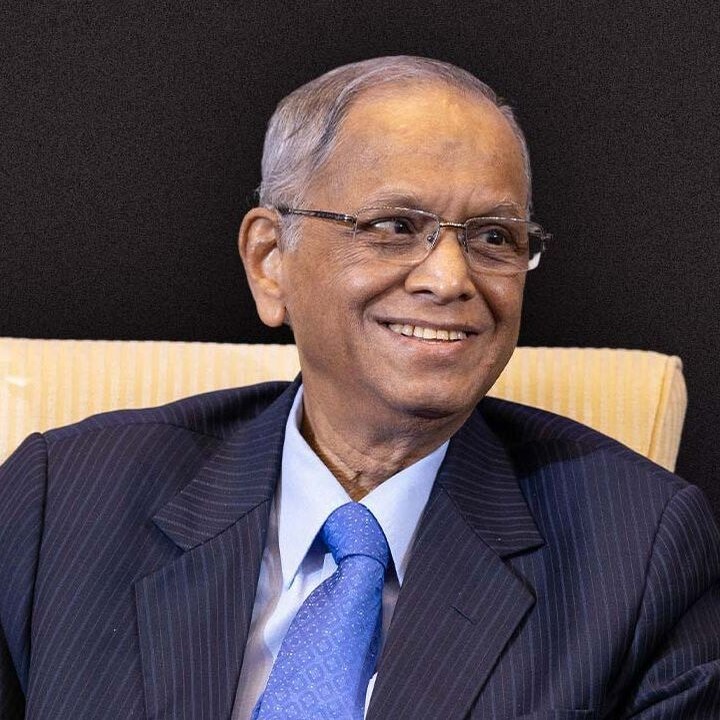
N. R. Narayana Murthy is an Indian IT pioneer and co-founder of Infosys. Known for ethical leadership, he helped build one of India’s largest software companies, shaping global outsourcing. A Padma Vibhushan awardee, Murthy has influenced corporate governance, entrepreneurship, and technology-led growth in India and globally respected business thought leader.
Introduction :
Early Life and Education
Narayana Murthy, the founder of Infosys, one of India’s leading IT companies, was born on August 20, 1946, in Mysore, Karnataka, India, to a middle-class family. His father, K. K. Murthy, was a high school teacher, and his mother, Vimala Murthy, was a homemaker. Growing up in an academically inclined household, Murthy was encouraged to pursue education seriously from a young age. This foundation in education would later play a pivotal role in his success as an entrepreneur and as a visionary in the IT industry.
Murthy completed his schooling in Mysore and then went on to pursue his engineering degree in Electrical Engineering from the National Institute of Engineering (NIE), Mysore. After completing his undergraduate studies, he joined the Indian Institute of Technology (IIT) Kanpur, where he earned a Master’s degree in Computer Science. His time at IIT Kanpur exposed him to the world of technology and innovation, sparking a passion for technology that would define his career. Murthy’s education, although steeped in technical subjects, also fostered a keen interest in business and leadership.
Early Career
Murthy’s career began with small stints in various companies, working with different technology firms in India. His first job was at IIM Ahmedabad as a senior systems analyst. However, his real breakthrough came when he worked for Tata Consultancy Services (TCS), a part of the Tata Group, which is one of India’s largest and most respected conglomerates. It was at TCS that he gained valuable experience and insight into the burgeoning software industry in India.
Despite his success at TCS, Murthy was not content with the idea of simply working for an established company. He had a vision of creating a company that would provide cutting-edge technology services to the world. He wanted to bring global standards to Indian software services and, in doing so, revolutionize the IT industry.
Founding Infosys
In 1981, Narayana Murthy took the bold decision to start his own company. With a mere $250 (around ₹10,000) in initial capital, he co-founded Infosys along with six other engineers: N. S. Raghavan, S. Gopalakrishnan (Kris), Nandan Nilekani, S. D. Shibulal, K. Dinesh, and Ashok Arora. The company started in a small apartment in Pune, India, with Murthy as the chief architect. They initially focused on providing software solutions and services to businesses in India.
Infosys, in its early years, struggled to compete with established global players in the IT industry. The company was operating in a country that was still largely cut off from global markets, and India’s infrastructure was not as developed as that of other countries. Despite these obstacles, Murthy and his co-founders were determined to make Infosys a success. They worked tirelessly to build a reputation for delivering high-quality IT solutions. Murthy’s leadership, vision, and deep technical expertise were crucial to the company’s growth.
By 1983, Infosys had secured its first major project: a software project for a US-based client. This was the beginning of Infosys’ long and successful relationship with global clients. Under Murthy’s leadership, Infosys expanded its operations beyond India and began to attract international clients.
Infosys: Growth and Global Expansion
In the late 1980s and early 1990s, Infosys began to make significant strides, both in terms of revenues and market presence. One of the key decisions that helped Infosys grow was its early investment in infrastructure and employee welfare. Murthy was committed to creating a work culture that valued innovation, teamwork, and quality. He also introduced employee stock options, a concept that was relatively new in India at the time. This not only helped retain top talent but also created a strong sense of ownership among the company’s employees.
In 1991, India’s economic liberalization policies opened up the market, making it easier for Indian companies to do business internationally. Infosys was quick to capitalize on this shift in the economy. Murthy, who had already built a strong foundation, expanded Infosys’s offerings to include services like consulting, systems integration, and business process outsourcing (BPO). Infosys’ unique approach to business, its dedication to high-quality delivery, and its ability to adapt to changing market conditions allowed it to grow rapidly during this period.
In 1993, Infosys became one of the first Indian companies to be listed on the NASDAQ (National Association of Securities Dealers Automated Quotations) stock exchange in the United States. This was a significant milestone in the company’s journey, as it gave Infosys access to global capital and allowed it to compete on a level playing field with some of the world’s largest technology firms. The NASDAQ listing was a testament to Narayana Murthy’s ability to build a globally recognized brand and to his commitment to transparency and corporate governance.
By the late 1990s, Infosys had become one of the top players in the global IT services industry, with major clients in North America, Europe, and Asia. The company’s revenues grew exponentially, and Murthy’s leadership was recognized globally. Infosys was known not only for its cutting-edge technological capabilities but also for its commitment to ethical business practices, which became a hallmark of the company under Murthy’s stewardship.
Leadership Style and Philosophy
Narayana Murthy’s leadership style is often described as a blend of humility, vision, and discipline. He is known for being hands-on and deeply involved in the day-to-day operations of Infosys, while also being a strategic thinker who could see the big picture. Murthy’s leadership philosophy emphasized the importance of values like integrity, transparency, and a strong work ethic. He was known for setting high standards for himself and his employees and for maintaining a sense of personal responsibility at every level of the organization.
One of Murthy’s most famous quotes is: “We believe in taking people along. You can never succeed if you don’t take people along.” This quote captures Murthy’s belief in teamwork and collaboration. His leadership was not about exercising control but about fostering a culture of innovation and trust.
Murthy was also a strong proponent of work-life balance and encouraged his employees to maintain a healthy personal life. At the same time, he pushed them to work hard and to strive for excellence in everything they did.
Philanthropy and Public Life
Apart from his business success, Murthy has been an active philanthropist and a strong advocate for social causes. His personal philosophy is rooted in the idea that businesses have a responsibility to society and that success should be used to make the world a better place.
In 2000, he and his wife, Sudha Murthy, established the Infosys Foundation, which focuses on supporting various initiatives in education, healthcare, rural development, and arts and culture. The foundation has supported numerous social initiatives in India and has made significant contributions to improving the lives of marginalized communities.
Murthy has also served on the boards of several educational and cultural institutions. He is a member of the Indian Prime Minister’s Council on Trade and Industry and has been a strong advocate for reforms in the Indian economy and governance. His views on technology, education, and business ethics have made him a sought-after speaker at conferences and forums around the world.
In 2006, Murthy stepped down as the CEO of Infosys and took on the role of Chairman Emeritus. Under his leadership, Infosys had grown into a global powerhouse, and he believed that it was time to hand over the reins to the next generation of leaders. However, Murthy remained involved in the company’s strategic decisions and continued to offer his guidance as an advisor.
Narayan Murtey Networth
Awards and Recognition
Throughout his career, Narayana Murthy has received numerous awards and accolades for his contributions to the IT industry and to society. Some of the major awards include:
- Padma Shri (2000) and Padma Bhushan (2008) from the Government of India for his contribution to trade and industry.
- Legion of Honour (2008) from the French government for his efforts in promoting business relations between France and India.
- CEO of the Year award by Business Week in 2003.
- Entrepreneur of the Year by Ernst & Young in 2006.
Murthy’s work has been widely recognized as transformative not just for Infosys, but for the entire Indian IT industry. His innovative ideas and ethical business practices have shaped the way Indian companies do business globally.

Later Years and Legacy
Even in his later years, Narayana Murthy remains an influential figure in the world of business and technology. His leadership of Infosys set a benchmark for corporate governance, innovation, and ethics in business. Although he formally stepped down from active management in Infosys, his legacy continues to influence the company and the broader tech ecosystem in India.
Murthy’s vision for India’s place in the global economy was always forward-thinking. He believed in the potential of India’s human capital and made it his mission to leverage that potential to create a global IT powerhouse. His vision turned Infosys into a company that not only excelled in technology but also set an example for ethical business practices and employee welfare.
In his later years, Murthy has remained a vocal advocate for issues like education reform, technological innovation, and social responsibility. He continues to serve on the boards of several leading institutions and is frequently invited to speak on leadership, entrepreneurship, and the future of technology.
As of today, Narayana Murthy’s journey from a small apartment in Pune to leading one of the most respected companies in the world stands as a testament to the power of perseverance, vision, and integrity.
Conclusion
N. R. Narayana Murthy’s life is a testament to the power of vision, integrity, and perseverance. From a small town in Karnataka to the global business stage, his journey reflects the transformative potential of ethical entrepreneurship.
In an era often marked by short-term gains and moral compromises, Murthy stands as a reminder that true success is built on values, not just valuation. His biography is not merely the story of a businessman but the story of a nation’s aspiration, resilience, and belief in ethical progress.
Narayan Murtey Date of Birth ?
20 August 1946
Birth Place In Narayan Murtey Live ?
Shidlaghatt Gaon is Indian state of Karnataka.
Narayan Murtey Networth ?
$5.0 billion (USD) as of early 2025