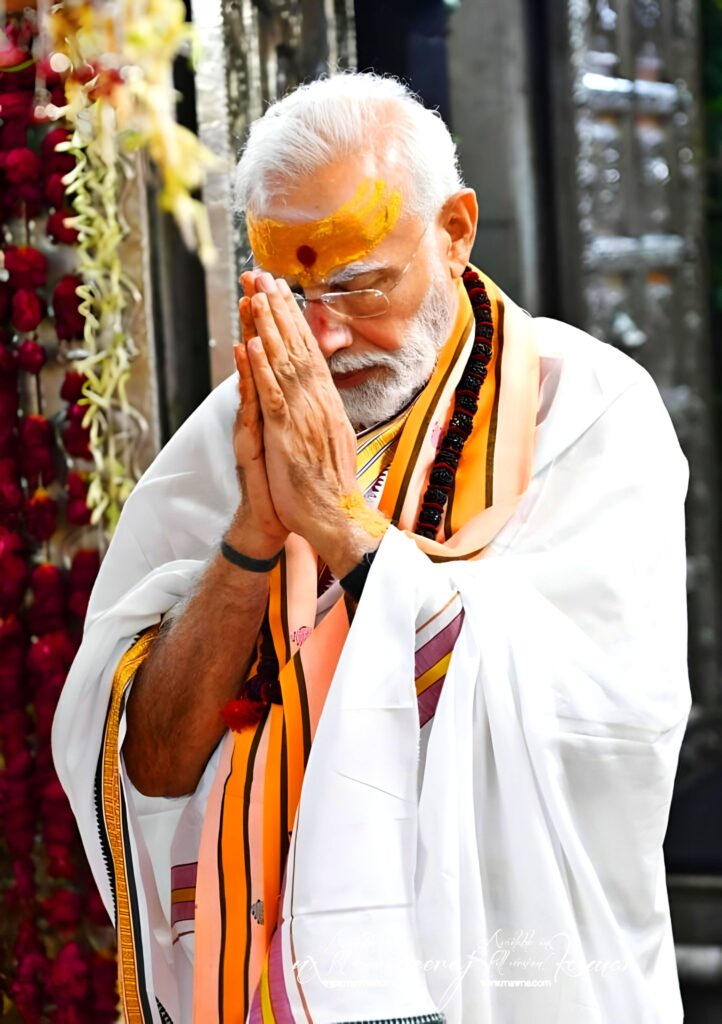
Narendra Modi is an Indian politician serving as Prime Minister of India since 2014. Born in 1950 in Gujarat, he rose from humble beginnings, served as Gujarat’s Chief Minister, and leads the Bharatiya Janata Party, shaping India’s governance, economy, and global relations.
Introduction
Narendra Damodardas Modi is one of the most influential and transformative political leaders in modern Indian history. Rising from humble beginnings to become the Prime Minister of the world’s largest democracy, Modi’s life story is often described as a journey from a small-town tea seller to a global statesman. His leadership has reshaped Indian politics, governance, economic policy, and India’s position on the world stage. Admired by supporters for his decisiveness, nationalism, and development-oriented vision, and criticized by opponents for his style of governance and ideological positions, Narendra Modi remains a central figure in contemporary India.
This biography explores Modi’s early life, ideological formation, political rise, tenure as Chief Minister of Gujarat, his leadership as Prime Minister of India, major policies and reforms, foreign relations, controversies, personal life, and his lasting impact on India’s political landscape.
Early Life and Family Background
Narendra Damodardas Modi was born on 17 September 1950 in Vadnagar, a small town in the Mehsana district of Gujarat, India. He was the third of six children born to Damodardas Mulchand Modi and Hiraben Modi. His father ran a small tea stall at the Vadnagar railway station, while his mother was a homemaker.
Modi’s family belonged to a modest background, and financial constraints were a defining feature of his early years. From a young age, Modi assisted his father in selling tea, an experience he often refers to as formative in shaping his work ethic, discipline, and understanding of ordinary people’s struggles. These early experiences later became a central theme in his political narrative, symbolizing perseverance and self-reliance.
Vadnagar itself had a strong historical and cultural environment, with ancient temples, libraries, and educational institutions. Modi was exposed early to debates, religious discussions, and social interactions that influenced his thinking.
Education And Early Influences
Narendra Modi completed his schooling in Vadnagar. Teachers and peers often described him as an average student academically but highly active in extracurricular activities, especially debates, theatre, and public speaking. Even as a child, he displayed strong leadership traits and organizational skills.
As a teenager, Modi came into contact with the Rashtriya Swayamsevak Sangh (RSS), a Hindu nationalist volunteer organization. He joined the RSS as a pracharak (campaigner) and became deeply influenced by its ideology of cultural nationalism, discipline, and service to society. The RSS played a decisive role in shaping Modi’s worldview, emphasizing nationalism, self-sacrifice, and social unity.
After completing school, Modi left home at a young age and spent several years traveling across India. During this period, he visited religious centers such as the Himalayas, Ramakrishna Mission ashrams, and other spiritual institutions. These years of wandering exposed him to India’s diversity, poverty, and spiritual traditions, further shaping his philosophical outlook.
Later, Modi returned to Gujarat and continued his association with the RSS. He pursued higher education through distance learning, earning a Bachelor’s degree in Political Science from the University of Delhi and a Master’s degree in Political Science from Gujarat University. His academic background in political science later helped him understand governance, administration, and political strategy.
Early Political Career
In the 1980s, Modi transitioned from being an RSS pracharak to active politics through the Bharatiya Janata Party (BJP), the political wing closely associated with the RSS. He quickly gained a reputation as a skilled organizer, strategist, and tireless worker.
Modi played an important role in strengthening the BJP’s organizational structure in Gujarat. He was involved in election campaigns, cadre training, and party expansion. His ability to manage complex political operations earned him recognition at the national level.
During the late 1980s and early 1990s, Modi worked closely with senior BJP leaders such as L. K. Advani and Murli Manohar Joshi. He was one of the key organizers of the BJP’s nationwide campaigns, including the Ram Janmabhoomi movement, which significantly altered Indian politics and contributed to the BJP’s rise as a major national party.
In 1995, when the BJP came to power in Gujarat, Modi was appointed Secretary of the BJP and later became General Secretary (Organization). His role involved coordinating between the party and the government, managing internal discipline, and strengthening grassroots support.
Becoming Chief Minister of Gujarat (2001)
In October 2001, Narendra Modi was appointed Chief Minister of Gujarat, replacing Keshubhai Patel, at a time when the state was facing political instability and economic challenges. Modi was not a member of the Gujarat Legislative Assembly at the time, but he won a by-election soon afterward.
His tenure as Chief Minister marked a turning point in his political career. Modi projected himself as a decisive, development-oriented leader focused on governance, infrastructure, and economic growth.
2002 Gujarat Riots and Controversy
One of the most controversial episodes of Modi’s career occurred in 2002, when Gujarat witnessed severe communal riots following the burning of a train coach in Godhra, which killed Hindu pilgrims. The riots resulted in the deaths of over a thousand people, mostly from the Muslim community, and caused widespread destruction.
Modi’s role during the riots has been intensely debated and scrutinized. Critics accused his government of failing to control the violence, while supporters argued that he acted within constitutional limits. Several investigations, including those monitored by the Supreme Court of India, did not find sufficient evidence to prosecute Modi personally.
Despite the controversy, the riots significantly shaped Modi’s national and international image. For several years, some Western countries restricted diplomatic engagement with him. Domestically, however, Modi consolidated his political base in Gujarat.
Development Model And Gujarat Years (2001–2014)
Modi served as Chief Minister of Gujarat for over 12 years, winning three consecutive elections (2002, 2007, and 2012). His governance during this period became known as the “Gujarat Model of Development.”
Key features of this model included:
- Rapid industrialization and investment-friendly policies
- Expansion of infrastructure such as roads, ports, and power supply
- Emphasis on urban development and economic growth
- Promotion of public-private partnerships
Under Modi’s leadership, Gujarat experienced high economic growth rates and attracted significant domestic and foreign investment. Initiatives such as the Vibrant Gujarat Global Summit showcased the state as a business destination.
However, critics argued that the development was uneven, with insufficient focus on social indicators such as health, education, and minority welfare. Nonetheless, Modi’s image as a strong administrator and pro-development leader gained national prominence.
Rise to National Leadership
By the early 2010s, Narendra Modi emerged as the BJP’s most prominent leader and its prime ministerial candidate. In 2013, he was officially declared the BJP’s candidate for Prime Minister in the 2014 general elections.
Modi ran a highly energetic and innovative campaign, using social media, mass rallies, and direct communication with voters. He promised development, job creation, clean governance, and an end to corruption. His slogan “Achhe Din Aane Wale Hain” (Good days are coming) resonated widely.
Prime Minister of India (2014)
2014 General Election Victory
In the 2014 Lok Sabha elections, the BJP won a historic majority, securing 282 seats on its own. Narendra Modi became the 14th Prime Minister of India, marking the first time in three decades that a single party achieved a full majority.
Major Policies And Reforms
Modi launched several major economic initiatives, including:
- Make in India: To promote manufacturing and job creation
- Goods and Services Tax (GST): A unified indirect tax system
- Insolvency and Bankruptcy Code (IBC): To improve business efficiency
- Digital India: To expand digital infrastructure and services
Social Welfare Programs
Key welfare schemes included:
- Swachh Bharat Abhiyan (Clean India Mission)
- Jan Dhan Yojana (financial inclusion)
- Ujjwala Yojana (free LPG connections for poor households)
- Ayushman Bharat (health insurance for the poor)
Narendra Modi Networth
Demonetization (2016)
In November 2016, Modi announced the demonetization of ₹500 and ₹1000 currency notes to combat black money and corruption. The move was bold and controversial, praised for intent but criticized for its economic disruption.
Foreign Policy and Global Role
Modi placed strong emphasis on foreign relations, engaging actively with world leaders. He strengthened ties with the United States, Japan, Europe, and neighboring countries. His foreign policy focused on:
- Strategic partnerships
- Diaspora engagement
- Regional security
- India’s role as a global power
Second And Third Terms
In 2019, Modi led the BJP to an even larger electoral victory. His second term saw major decisions such as:
- Abrogation of Article 370 in Jammu and Kashmir
- Citizenship Amendment Act (CAA)
- Strong national security posture
In 2024, Modi secured a third consecutive term as Prime Minister, becoming one of the longest-serving leaders in Indian history.
Leadership Style and Ideology
Modi is known for:
- Centralized decision-making
- Strong communication skills
- Emphasis on nationalism and cultural identity
- Use of technology and direct public outreach
Supporters view him as decisive and visionary, while critics express concerns over democratic institutions and dissent.
Personal Life
Narendra Modi married Jashodaben Modi at a young age, but the couple has lived separately for decades. Modi has no children and lives a highly disciplined lifestyle. He is known for his simplicity, yoga practice, and long working hours.
Legacy And Impact
Narendra Modi’s legacy is still unfolding. He has redefined Indian politics, strengthened the BJP as a dominant force, and reshaped governance and policy discourse. Whether viewed as a transformative reformer or a polarizing leader, his impact on India is undeniable.
Conclusion
Narendra Modi’s journey from a small-town boy to Prime Minister of India is one of determination, ambition, and political skill. His leadership has left a deep imprint on India’s economy, politics, and global standing. As India continues to evolve, Modi’s role in shaping its present and future will remain a subject of study, debate, and historical significance.
Narendra Modi Date Of Birth ?
17 September 1950
Narendra Modi Entry In Politics ?
Narendra Modi’s entry into formal, mainstream politics began in 1987.
Narendra Modi Which Year Of Narendra Modi First Time PM ?
Prime Minister of India on May 26, 2014.