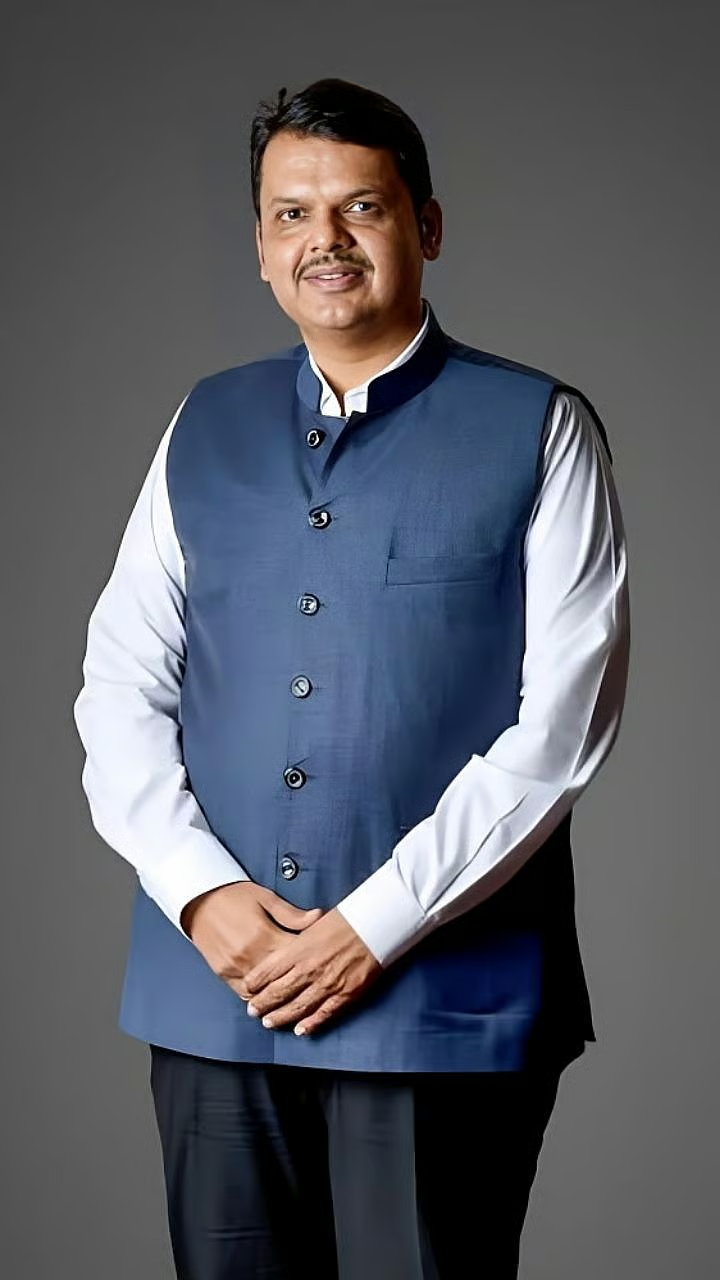
Devendra Gangadharrao Fadnavis is an Indian politician from the BJP, currently serving as Chief Minister of Maharashtra. He began as Nagpur corporator, became the city’s youngest mayor, and led Maharashtra as CM from 2014–2019 and again since 2024. He represents Nagpur South-West in the state assembly.
Introduction
Devendra Gangadharrao Fadnavis is among the most influential political leaders in contemporary Indian politics. A senior leader of the Bharatiya Janata Party (BJP), he has served multiple terms as the Chief Minister of Maharashtra, one of India’s largest and most economically significant states. Known for his administrative vigor, governance reforms, and political acumen, Fadnavis has built a reputation as both a strategist and a grassroots leader.
He remains a central figure in Maharashtra’s political landscape, balancing developmental priorities with evolving political dynamics. This biography traces his life from early years to political ascendance and public impact.
Early Life and Family
Devendra Fadnavis was born on 22 July 1970 into a Maharashtrian Marathi Brahmin family in Nagpur, Maharashtra. His father, Gangadhar Fadnavis, was a respected member of the Maharashtra Legislative Council and a senior leader of the Jan Sangh and later the BJP, influencing Devendra’s early exposure to politics. His mother, Sarita Fadnavis, was involved in social initiatives and community work.
Growing up in Nagpur, a city known for its cultural heritage and as a stronghold of the Rashtriya Swayamsevak Sangh (RSS), Devendra imbibed political awareness early. Nagpur’s political and intellectual environment, particularly its RSS influence, shaped his ideological leanings.
Education Background
Devendra Fadnavis pursued a comprehensive education combining law, business, and management—a foundation that would later inform his governance style.
- Schooling: He did his early schooling in Nagpur, studying at Saraswati Vidyalaya School and Indira Convent, followed by higher secondary education at Dharampeth Junior College.
- Law Degree: He holds a Bachelor of Laws (LLB) from Government Law College, Nagpur University, completed in 1992.
- Management Qualification: Fadnavis also earned a Postgraduate Degree in Business Management, equipping him with strategic and administrative insights.
- International Diploma: He completed a Diploma in Project Management from the DSE-German Foundation for International Development, Berlin, reflecting his interest in structured governance and project implementation.
His diverse education blended legal precision, managerial clarity, and technical expertise—attributes that later helped in policy formulation and administrative reforms.
Entry into Politics and Early Leadership
Fadnavis’s political journey began at a young age:
- RSS and ABVP Involvement: He became associated with the Rashtriya Swayamsevak Sangh (RSS) and its student wing, Akhil Bharatiya Vidyarthi Parishad (ABVP), in the late 1980s. These early associations steered him toward organized politics.
- City Politics: In 1992, at age 22, he was elected as a Councillor of the Nagpur Municipal Corporation, marking his formal entry into electoral politics.
- Mayor of Nagpur: In 1997, at just 27 years old, he became the youngest Mayor of Nagpur—and one of the youngest mayors in India. He was re-elected and remains the only person to serve two terms as Mayor in Council for Nagpur.
These early roles highlighted his leadership potential and helped him build a solid base in Nagpur’s political circles.
Rise in State Politics
First Electoral Victory and Legislative Career
Fadnavis contested the 1999 Maharashtra Legislative Assembly election from the Nagpur South West constituency and won. This marked the beginning of a long legislative career. Since then, he has been elected consecutively as MLA for multiple terms.
His electoral success established him as a consistent voice within the state legislature and showcased his strong connection with voters.
Roles within BJP
Beyond legislative duties, Fadnavis rose in the Bharatiya Janata Party’s organisational structure:
- Held posts such as Ward Convener, Nagpur City President of Bharatiya Janata Yuva Morcha, and State Vice President.
- Became National Vice President of BJP Yuva Morcha and later held key organisational responsibilities.
- Served as General Secretary of the BJP Maharashtra unit.
- Led major election campaigns, including Lok Sabha and Assembly elections in Maharashtra.
His organisational roles demonstrated the party’s trust in his leadership abilities and strategic thinking.
First Term as Chief Minister (2014–2019)
Appointment and Government Formation
In 2014, following the Maharashtra Assembly elections, the BJP emerged as the single largest party. After internal party consensus and legislative support, Fadnavis was sworn in as Chief Minister of Maharashtra on 31 October 2014—becoming one of the youngest to hold the office and the first in nearly five decades to complete a full five-year term.
His leadership was backed by key national figures, with Prime Minister Narendra Modi reportedly describing him as “Nagpur’s gift to the country.”
Governance Style and Administrative Reforms
Fadnavis’s governance style blended technology, accountability, and citizen responsiveness:
- Right to Service Act: He introduced this pioneering act to ensure timely delivery of public services, making Maharashtra one of India’s first states to enact such legislation.
- Aaple Sarkar & E-Governance Initiatives: He expanded online service delivery with platforms like Aaple Sarkar for government services and launched digital systems across departments.
- Crime Tracking: Under his initiative, the Crime and Criminal Tracking Network System (CCTNS) aimed to digitise police records and improve law enforcement efficiency.
These measures modernised public administration and strengthened bureaucratic accountability.
Major Development Projects
Fadnavis oversaw several transformative infrastructure and policy initiatives:
Infrastructure and Connectivity
- Advances in Mumbai Metro, Pune Metro, and Nagpur Metro systems.
- Launch and acceleration of the Mumbai Coastal Road project.
- Progress on the Mumbai Trans-Harbour Link (MTHL).
- Expansion of state highways and expressways, including the Samruddhi Mahamarg (Nagpur–Mumbai Expressway).
These efforts sought to reduce congestion, boost economic activity, and enhance mobility across the state.
Water Conservation and Agriculture
The Jalyukt Shivar Abhiyan emerged as a flagship program to combat drought conditions by building decentralized water structures across villages. This mission constructed over 600,000 water conservation initiatives, dramatically improving irrigation and groundwater levels.
Economic Growth and Investment Attraction
Under his leadership, Maharashtra became a favorite destination for Foreign Direct Investment (FDI), accounting for nearly half of India’s FDI inflows at one point—a testament to investor confidence in the state’s business environment.
He launched summit events such as Magnetic Maharashtra, drawing major corporations and bolstering industrial growth.
Devendra Fadnavis Networth
Social Development and Citizen Programs
Fadnavis also emphasised inclusive growth:
- Village Social Transformation Mission encouraged community participation.
- SMART Agriculture Programs aimed to boost farming value chains.
- Housing Initiatives under national schemes improved access for the urban and rural poor.
With such programs, the government sought to combine economic progress with grassroots upliftment.
Post-2019 Political Journey
2019 Elections and Opposition Role
When the BJP did not secure a majority in 2019, Fadnavis resigned as CM and transitioned to the role of Leader of Opposition in the Maharashtra Legislative Assembly. During this period, he remained an active critic of the ruling alliance and a key strategist for the BJP.
Political Realignment and Deputy Chief Minister (2022–2024)
In 2022, political realignments in Maharashtra resulted in a new government led by Eknath Shinde, a former Shiv Sena leader allied with the BJP. In the resulting coalition, Devendra Fadnavis served as Deputy Chief Minister, holding important portfolios including Home Affairs, Finance, and Law.
During this period, he continued policy initiatives such as Jalyukt Shivar 2.0, supported infrastructure development, and coordinated governance across departments.
Return as Chief Minister (2024–Present)
In the 2024 Assembly elections, the BJP-led alliance (Mahayuti) secured a decisive mandate. Devendra Fadnavis was sworn in again as Chief Minister in December 2024, reaffirming his leadership and political appeal in Maharashtra.
Leadership Style and Public Persona
Devendra Fadnavis is known for a methodical, technology-driven governance style, emphasizing evidence, efficiency, and administrative discipline. His communication approach—grounded in data and results—has earned respect across political lines.
In public life, he is often portrayed as articulate and composed, with an ability to navigate complex political situations and build consensus when necessary.
Personal Life
Fadnavis is married to Amruta Fadnavis, a banker and social activist engaged in women’s empowerment and community work. The couple has a daughter, Divija Fadnavis.
Despite his political prominence, Fadnavis has maintained a relatively modest personal profile. His declared assets include residential properties in Nagpur and investments in modest financial instruments—far from the extravagant lifestyles often associated with public office.
Awards and Recognition
Fadnavis’s leadership has earned several honours:
- Nag Bhushan Award (2016) for his contributions to Vidarbha’s development.
- Honorary Doctorate from Osaka City University, Japan, for his socio-economic reform initiatives.
- Served as Secretary of the Global Parliamentarians Forum on Habitat (Asia region).
His international recognition reflects not only domestic influence but also contributions to global policy dialogues on development, agriculture, and sustainability.
Controversies and Public Debate
Like most major public figures, Fadnavis’s career has not been without controversy. His political decisions, administrative directives, and the alliances formed post-2019 have drawn criticism from opposition groups and commentators. While specific controversies are varied, debates often centre on governance choices and political alliances—common\ facets of India’s dynamic political environment.
(Note: Specific recent controversies were reported in news sources but outside the strict biography scope; they include internal political disputes and administrative allegations. These are part of ongoing political discourse but not exhaustively covered here.)
Legacy and Impact
Devendra Fadnavis’s contributions to Maharashtra’s political and developmental landscape are significant:
- Administrative Reforms: Digitization of services and governance frameworks.
- Infrastructure Growth: Major projects accelerating connectivity.
- Water Management: Strategic focus on drought mitigation.
- Economic Positioning: Elevating Maharashtra as an investment hub.
- Political Governance: Sustained tenure and electoral success.
His journey—from a young city councillor to long-serving Chief Minister—illustrates a blend of organisational skill, strategic leadership, and public policy focus. As he continues to shape Maharashtra’s future, his legacy remains central to understanding contemporary state politics.
Conclusion
Devendra Fadnavis’s political journey reflects the rise of a disciplined, reform-oriented leader shaped by strong ideological roots, solid education, and sustained grassroots engagement. From his early days as a municipal councillor in Nagpur to becoming one of Maharashtra’s most influential Chief Ministers, his career demonstrates continuity, resilience, and strategic foresight. His tenure has been marked by an emphasis on good governance, infrastructure development, digital administration, and economic growth, alongside efforts to address long-standing challenges such as drought management and urban congestion.
Devendra Fadnavis Date Of Birth ?
22 July 1970
Devendra Fadnavis Wife Name ?
Amruta Fadnavis
Devendra Fadnavis Networth ?
Devendra Fadnavis Declares Assets Worth Rs 13.27 Crore.