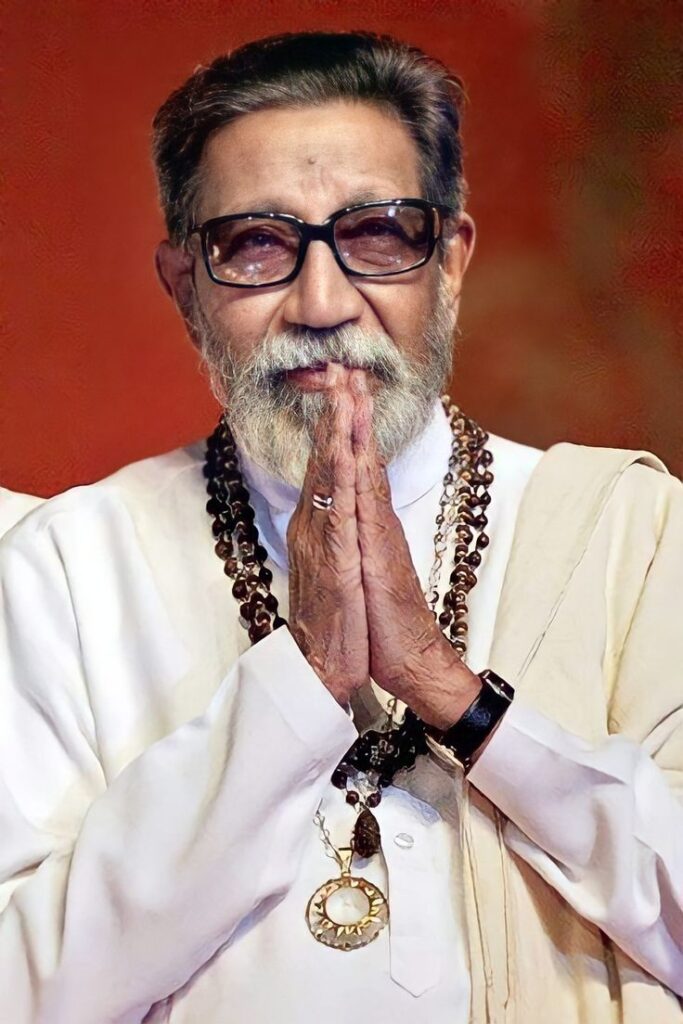
Balasaheb Thackeray (1926–2012) was an Indian cartoonist turned politician, founder of Shiv Sena. A powerful orator, he shaped Maharashtra’s politics, championed Marathi identity, and wielded immense influence in Mumbai through populist nationalism, cultural activism, and uncompromising leadership. His legacy remains controversial yet enduring in Indian public life and regional politics.
Introduction
Bal Keshav Thackeray, popularly known as Balasaheb Thackeray, was one of the most influential, controversial, and charismatic political leaders in modern Indian history. He was not merely a politician but a phenomenon—someone who shaped public discourse, altered Maharashtra’s political landscape, and inspired fierce loyalty among millions. Founder of the Shiv Sena, Balasaheb wielded enormous power without ever holding an elected office, a rare feat in democratic politics.
Born as a cartoonist and satirist, he rose to become a mass leader whose words could sway elections, shut down cities, and ignite passionate debate across India. Loved by supporters and criticized by opponents, Balasaheb Thackeray remains a towering figure whose impact on Maharashtra and Indian politics continues long after his death.
This biography explores his life in depth—his childhood, family background, early career, political journey, ideology, leadership style, controversies, personal life, death, and lasting legacy.
Early Life and Family Background
Birth and Childhood
Bal Keshav Thackeray was born on January 23, 1926, in Pune, then part of the Bombay Presidency under British rule. He belonged to a Marathi-speaking Chandraseniya Kayastha Prabhu (CKP) family, a community known for its intellectual and administrative traditions.
Balasaheb grew up in a politically and socially conscious environment, which had a deep influence on his worldview. His childhood coincided with the Indian freedom struggle, and nationalist ideas were common in his household.
Father: Keshav Sitaram Thackeray
Balasaheb’s father, Keshav Sitaram Thackeray, popularly known as Prabodhankar Thackeray, was a prominent social reformer, author, and rationalist. Prabodhankar was deeply opposed to social evils such as caste discrimination, superstition, and blind religious practices. He was also a vocal advocate for Marathi pride and regional identity.
Prabodhankar’s writings and activism significantly influenced Balasaheb’s thinking, especially regarding social justice, Hindu identity, and the rights of Maharashtrians.
Education Details
Balasaheb studied at Rashtriya Vidyalaya High School in Mumbai (then Bombay). He was an average student academically but displayed exceptional talent in drawing and caricature from a young age. His creative inclination would later become the foundation of his professional life.
He did not pursue higher education extensively, choosing instead to follow his passion for art and journalism.
Early Career as a Cartoonist
Work in Journalism
Balasaheb began his career as a cartoonist. His sharp wit, biting satire, and bold political commentary quickly gained attention. He initially worked for the Free Press Journal, one of Mumbai’s leading English-language newspapers.
His cartoons were known for their fearless criticism of politicians, bureaucracy, and social hypocrisy. Even at this early stage, Balasaheb showed traits that would later define his political career—outspokenness, defiance of authority, and mass appeal.
Marmik Magazine
In 1960, Balasaheb launched his own Marathi weekly magazine called “Marmik”, which became a turning point in his life. Through Marmik, he began highlighting issues faced by the Marathi-speaking population, particularly unemployment and discrimination in Mumbai.
The magazine criticized the growing dominance of South Indians and Gujaratis in clerical jobs and business, arguing that native Maharashtrians were being sidelined in their own state. These themes resonated deeply with the Marathi middle and working classes.
Marmik soon became more than a magazine—it was a platform for mobilization and ideological formation.
Founding of Shiv Sena
Birth of a Movement
On June 19, 1966, Balasaheb Thackeray founded the political organization Shiv Sena, named after Chhatrapati Shivaji Maharaj, the 17th-century Maratha warrior king and a symbol of Marathi pride and resistance.
The Shiv Sena was initially formed as a sons-of-the-soil movement, aimed at securing jobs and opportunities for Maharashtrians, especially in Mumbai.
Ideology and Early Objectives
The early ideology of Shiv Sena focused on:
- Protection of Marathi language and culture
- Employment for Marathi youth
- Opposition to perceived outsider dominance
- Strong regional identity
Balasaheb’s speeches were fiery, emotional, and direct. He used simple language that connected instantly with the masses.
Rise in Popularity
Shiv Sena rapidly expanded its influence through:
- Aggressive street-level activism
- Strong local leadership (Shakhas)
- Emotional appeal to Marathi identity
Balasaheb encouraged discipline, loyalty, and unquestioning commitment within the organization. The party’s grassroots network soon spread across Mumbai and Maharashtra.
Entry into Electoral Politics
Municipal and State Politics
Although Balasaheb himself never contested elections, Shiv Sena began participating in municipal and state-level politics. The party achieved major success in the Brihanmumbai Municipal Corporation (BMC), which remains one of Asia’s richest civic bodies.
Control of the BMC gave Shiv Sena financial and administrative power, further strengthening its position.
Alliance with BJP
In the late 1980s and early 1990s, Shiv Sena shifted its ideology from regionalism to Hindutva, aligning with the Bharatiya Janata Party (BJP).
Balasaheb emerged as a strong proponent of Hindu nationalism, openly supporting causes such as:
- Ram Janmabhoomi movement
- Uniform Civil Code
- Opposition to what he termed “pseudo-secularism”
Chief Ministership Era (1995–1999)
Shiv Sena–BJP Government
In 1995, the Shiv Sena–BJP alliance won the Maharashtra Assembly elections. Manohar Joshi became Chief Minister, followed later by Narayan Rane.
Though Balasaheb held no official post, he was widely regarded as the real power behind the government. Decisions were often believed to be taken with his approval.
Renaming of Bombay to Mumbai
One of the most symbolic acts of this government was renaming Bombay to Mumbai in 1995, reflecting Marathi identity and honoring the local goddess Mumbadevi.
Governance and Criticism
Supporters credit the government with infrastructure initiatives and assertive leadership. Critics accuse it of:
- Encouraging intolerance
- Undermining democratic institutions
- Patronizing violence
Leadership Style and Influence
The Remote Control Leader
Balasaheb Thackeray’s leadership style was unique. He ruled through:
- Charismatic authority
- Public speeches
- Editorials in Saamana, the Shiv Sena mouthpiece
He was often described as a “remote control” leader, influencing governments without holding office.
Oratory and Mass Appeal
Balasaheb’s speeches were known for:
- Sharp humor
- Sarcasm
- Provocative statements
His ability to connect emotionally with audiences made him one of India’s most powerful mass leaders.
Balasaheb Thackeray Networth
Controversies and Criticism
Balasaheb Thackeray was no stranger to controversy.
Communal Politics
He was frequently criticized for:
- Anti-Muslim rhetoric
- Support for aggressive Hindutva
- Comments on minorities
His role during the 1992–93 Mumbai riots remains one of the most debated aspects of his legacy.
Freedom of Speech Issues
Critics accused him of:
- Threatening journalists
- Intimidating artists and writers
- Suppressing dissent
Supporters, however, viewed him as a fearless nationalist who spoke uncomfortable truths.
Personal Life
Marriage And Family
Balasaheb married Meenatai Thackeray, who maintained a low public profile. The couple had one son, Bindumadhav Thackeray, who died in a car accident in 1996.
Balasaheb’s grandson, Uddhav Thackeray, later emerged as a political leader and eventually became Chief Minister of Maharashtra (2019–2022).
Lifestyle And Interests
Despite his power, Balasaheb lived relatively simply. He loved:
- Cartooning
- Photography
- Wildlife
- Reading
He was known to be affectionate toward animals, especially dogs.
Declining Health and Death
In his later years, Balasaheb suffered from multiple health issues. He gradually withdrew from public appearances, though his influence remained intact.
Balasaheb Thackeray passed away on November 17, 2012, at the age of 86, in Mumbai.
Public Reaction
His death led to:
- Massive public mourning
- Shutdown of Mumbai
- One of the largest funeral processions in Indian history
Millions paid their respects, reflecting his unparalleled influence.
Legacy Details
Political Legacy
Balasaheb Thackeray left behind:
- A powerful political organization
- A distinct brand of politics
- A lasting impact on regional and national discourse
Shiv Sena remains a major force in Maharashtra politics, though it has undergone ideological and organizational changes.
Cultural Impact
Balasaheb transformed:
- Marathi pride into political power
- Street politics into mass mobilization
- Regional identity into a national conversation
A Polarizing Figure
To supporters, Balasaheb was:
- A Hindu Hriday Samrat (Emperor of Hindu Hearts)
- A protector of Marathi identity
To critics, he was:
- Authoritarian
- Divisive
- Intolerant
Yet, few deny his significance in Indian political history.
Conclusion
Balasaheb Thackeray was a man of contradictions—an artist turned firebrand, a leader without office, a democrat accused of authoritarianism. His life story is inseparable from the story of modern Maharashtra.
Whether admired or criticized, Balasaheb Thackeray’s influence remains undeniable. He reshaped political communication, redefined regional politics, and demonstrated how charisma and conviction could rival institutional power.
Even years after his death, Balasaheb Thackeray continues to shape debates, inspire followers, and provoke discussion—an enduring testament to a life that left an indelible mark on India.
Balasaheb Thakre Date Of Birth ?
23 January 1926
Balasaheb Thakre Networth ?
Total Assets Around ₹143 crore, including property And investments.
Balasaheb Thakre Death Reason ?
Cardiac Arrest (heart attack).