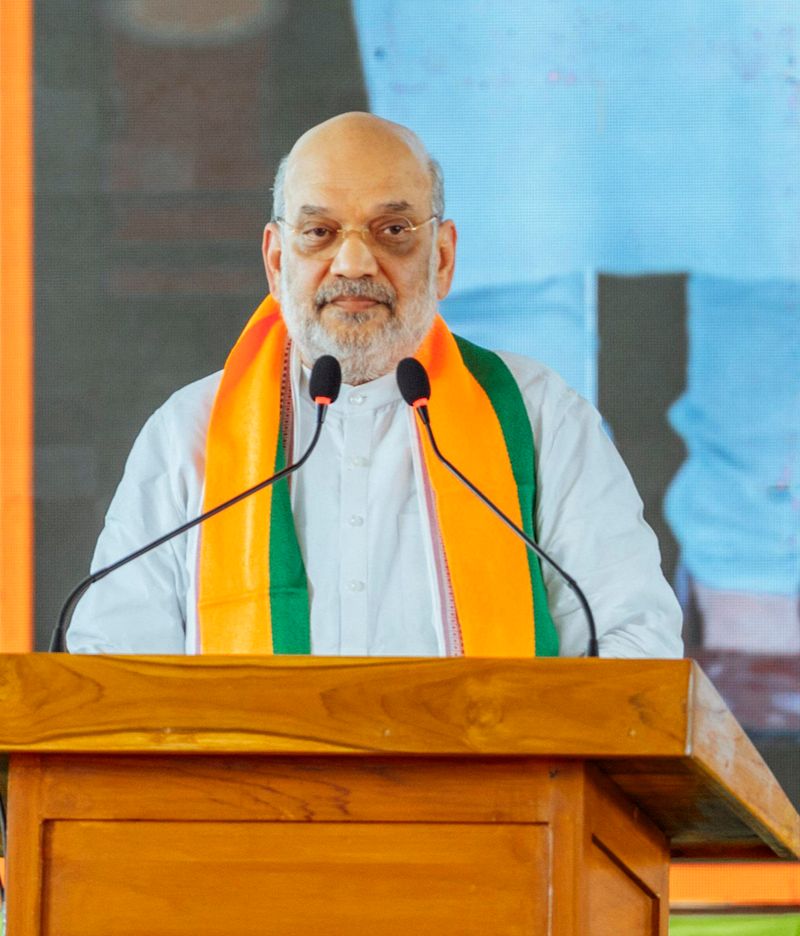
Amit Shah is an Indian politician and senior leader of the Bharatiya Janata Party (BJP). Born on October 22, 1964, in Mumbai, he has been a close associate of Prime Minister Narendra Modi for decades. Shah served as BJP National President from 2014 to 2020 and has been India’s Union Minister of Home Affairs since 2019. He is known for his organizational skills, electoral strategies, and influence in Indian politics.
Introduction:
Amitbhai Anilchandra Shah — commonly known as Amit Shah — is an Indian politician, strategist, and current Union Minister of Home Affairs and Minister of Cooperation in the Government of India. He is widely recognized as one of the most powerful and influential politicians in modern Indian history, having shaped not only the electoral success of his party — the Bharatiya Janata Party (BJP) — but also the direction of the national political landscape. Shah is considered the chief architect of the BJP’s rise from a regional party to a dominant national force.
Throughout his career spanning over three decades, Shah has been a key leader at both state and national levels, known for his organizational acumen, election management skills, and strategic ingenuity.
Early Life and Family Background
Amit Shah was born on 22 October 1964 in Bombay (present-day Mumbai), Maharashtra, India, into a prosperous Gujarati family. His parents were Mr. Anilchandra Shah and Mrs. Kusumben Shah. His grandfather was a well-to-do trader in the princely state of Mansa in the Baroda district of Gujarat, and his family maintained strong cultural and religious roots in Gujarat.
Shah spent much of his childhood in his ancestral village Mansa, where he received his early education. Influenced by traditional Indian values, he was taught Indian scriptures, historical texts, grammar, and epic literature under the supervision of scholars — teachings that shaped his worldview and ideological outlook from a young age.
His early years were marked by a strong interest in Indian history and culture, and he became involved in political activity at a young age. At just 13 years old, during the 1977 general elections (during the Emergency aftermath), he campaigned by pasting election posters for a Jana Sangh (the predecessor to the BJP) candidate — an experience that kindled his interest in active politics.
Shah’s mother had a deep influence on him; she was deeply inspired by Gandhian values, which helped nurture his early civic and nationalistic instincts.
Education and Early Political Leanings
After completing primary education in Gujarat, Shah’s family moved to Ahmedabad, where he continued his studies. While academic records vary in detail, his formative years were heavily influenced by his involvement with the Rashtriya Swayamsevak Sangh (RSS) — a right-wing, Hindu nationalist volunteer organization — which he joined at the age of 16.
In the RSS, Shah became active in the Akhil Bharatiya Vidyarthi Parishad (ABVP), its student wing. He quickly moved up within the organization, becoming joint secretary of the Gujarat ABVP by 1982.
In 1987, Shah formally joined the Bharatiya Janata Yuva Morcha (BJYM), the youth wing of the BJP, marking the beginning of his formal association with the party.
These early years laid the groundwork for Shah’s political ideology and strategic orientation. His time in the RSS instilled in him a disciplined, cadre-based approach to politics focused on organizational strength, voter outreach, and social messaging — tools he would later use to transform the BJP and Indian electoral politics.
Rise in Gujarat Politics
First Steps in Electoral Politics
Shah’s political career in the BJP began with organizational work in Ahmedabad, after which he rose steadily through party ranks. His breakthrough in electoral politics came in 1997 when he won a by-election to the Gujarat Legislative Assembly from the Sarkhej constituency. This victory marked his official entry into legislative politics.
Shah retained this constituency in the 1998 assembly elections, which saw the BJP form the state government under Keshubhai Patel.
Close Association with Narendra Modi
During this period, Shah developed a strong political partnership with Narendra Modi, then an emerging leader within the BJP and soon to become Chief Minister of Gujarat. Shah and Modi’s partnership would become one of the most consequential alliances in Indian politics.
After Patel’s resignation in 2001, Modi became Chief Minister of Gujarat. Though controversial due to the 2002 Gujarat riots, the government won re-election later that year. Shah was appointed as a minister in Modi’s cabinet, holding key portfolios such as Home, Law and Justice, Civil Defense, Transport, and more. His leadership in these roles helped him consolidate political strength and expand his administrative experience.
Organizational, Security, and Cooperative Initiatives
As a minister, Shah focused on strengthening law enforcement and administrative efficiency in Gujarat. He was also involved in modernizing police infrastructure and improving the functioning of state departments. During this period, Gujarat’s law and order outcomes improved in several metrics, earning praise from governmental bodies such as the National Crime Records Bureau.
Shah also played a role in expanding cooperative movements and financial institutions within the state. His leadership in cooperative banking strengthened local economic structures and aided his reputation as an effective administrator.
National Politics and Strategic Leadership
National Party Roles and Campaign Strategy
In 2013, Shah was appointed as National General Secretary of the BJP. Within this role, he was entrusted with key responsibilities in party organization and handled election strategy for Uttar Pradesh — India’s largest Lok Sabha (national parliament) constituency bloc, sending 80 MPs to the parliament.
His management of the 2014 general election campaign was credited with delivering an unprecedented result for the BJP. The party won 282 seats, surpassing its target and securing a decisive majority. For many analysts, this success was as much Shah’s achievement as it was the result of Narendra Modi’s popularity.
Following this victory, Shah was appointed President of the BJP in July 2014 — at just 49, one of the youngest to lead the party at the national level.
Under his leadership, the BJP not only expanded its electoral footprint but also became one of the largest political parties in the world in terms of membership. Shah emphasized a modern organizational structure, aggressive outreach campaigns, and meticulous booth-level management.
BJP Expansion Across India
During Shah’s presidency, the BJP achieved significant electoral successes in various states: expanding its influence in Haryana, Assam, Tripura, Maharashtra, and other states. His leadership was often credited with turning the BJP into a truly pan-India political force.
By combining organizational discipline, cadre mobilization, and strategic messaging, Shah redefined the way Indian elections were contested — focusing on micro-level data, personalized door-to-door campaigns, and targeted voter outreach.
Parliament and Ministerial Role
Entry into National Parliament
In 2017, Shah was elected to the Rajya Sabha, the upper house of India’s Parliament, representing Gujarat.
In the 2019 Lok Sabha elections, Shah contested and won the Gandhinagar seat — one of the BJP’s strongest bastions, reflecting his deep roots in the state.
Home Minister of India (2019–Present)
After the BJP’s victory in the 2019 general election, Shah was appointed Union Minister of Home Affairs, one of the most powerful portfolios in the Indian government. He was re-appointed as Home Minister after the 2024 general elections, becoming the longest-serving Home Minister in India’s history — surpassing the previous record held by Lal Krishna Advani.
In July 2021, Shah also took on the newly created role of Minister of Cooperation, reflecting the central government’s focus on revitalizing India’s cooperative sector.
Key Policy Initiatives
As Home Minister, Shah has overseen several landmark policy changes and internal security strategies. These include:
- Abrogation of Article 370: Removing the special constitutional status of Jammu & Kashmir in 2019, an initiative considered one of the most significant constitutional changes in India’s post-independence history.
- Citizenship Amendment Act (CAA): Shah championed this law, which provided a path to citizenship for persecuted religious minorities from neighboring countries. This legislation sparked large-scale protests and national debate.
- Focus on combating religious terrorism, left-wing extremism, and separatist movements, with policy emphasis on strengthening internal security and surveillance systems.
Under his leadership, agencies under the Home Ministry have also intensified actions against organized crime, drug trafficking, and extremist networks.
Controversies and Criticisms
Amit Shah’s career has also been marked by controversy and criticism:
2002 Gujarat Riots and Legal Charges
During his tenure as a minister in Gujarat, Shah faced legal accusations related to alleged extrajudicial killings in the Sohrabuddin Sheikh case. In 2010, he was arrested by the Central Bureau of Investigation (CBI) and spent three months in jail. Later, a special CBI court cleared him of charges in 2014.
His critics argue that his leadership in Gujarat during the riots and his proximity to state decision-making raised questions about administrative accountability.
Surveillance Allegations
In 2013, an investigative report accused Shah of involvement in the illegal surveillance of a private citizen using state resources — an allegation he dismissed as politically motivated.
Polarization and Ideological Criticism
International media and human rights organizations have occasionally criticized Shah’s political stance and policies as divisive, especially regarding secularism and religious minority rights. For example, some outlets depict his leadership as reflecting an aggressive ideological bent that reshapes India’s politics in ways that marginalize minority voices.
Amit Shah Networth
Diplomatic Contentions
In 2024, Canada accused Shah of involvement in alleged plots against Sikh separatists residing on Canadian soil — a charge vehemently denied by India. These allegations led to diplomatic tensions, though no independent, verified evidence was presented publicly.
Shah’s critics argue that such allegations, whether substantiated or not, highlight the geopolitical implications of his hardline policy orientation.
Personal Life and Interests
Amit Shah is married to Sonal Shah, and the couple has one son, Jay Shah. His son is a businessman and cricket administrator, serving in positions such as the president of the Board of Control for Cricket in India (BCCI) and the Asian Cricket Council.
Shah is known for his interests outside politics. He is an avid reader, particularly of history, and enjoys games like chess. His engagement in sports administration — especially his roles with chess and cricket associations in Gujarat — reflects his broader interest in promoting sports.
Legacy and Impact
Amit Shah’s legacy is complex and multifaceted. To supporters, he is a master strategist who transformed political campaigning and organizational discipline in India, contributing to unprecedented electoral successes and reshaping the national discourse.
To critics, he is a polarizing figure whose approach emphasizes partisan consolidation and ideological realignment at the expense of pluralism.
Regardless of viewpoint, Shah’s influence on Indian politics over the past two decades is undeniable. He has helped the BJP expand into territories once considered outside its core regions, strengthened internal party machinery, and played a central role in defining the ruling government’s policies — making him one of the most consequential political leaders in India’s post-independence era.
Conclusion
From his early days in Gujarat’s political landscape to his current role in the central government, Amit Shah’s journey has been marked by strategic brilliance, effective organization, and controversial policymaking. Whether seen as a visionary leader or a contentious political figure, his role in Indian politics remains pivotal. His ability to combine grassroots mobilization with high-level policy initiatives has altered India’s political map and continues to influence the trajectory of Indian governance and democratic discourse.
Amit Shah Date Of Birth ?
October 22, 1964,
Amit Shah Networth ?
assets were over ₹65 crore (approx. $7.8 million) in 2024.
Amit Shah Politics Party ?
Bharatiya Janata Party (BJP)