A. P. J. Abdul Kalam (1931–2015) was an Indian aerospace scientist and statesman. Known as the Missile Man of India, he led key space and defense programs, contributed to Pokhran-II nuclear tests, and served as India’s 11th President, inspiring millions through humility, vision, and education, leadership, innovation, and national service.
Introduction
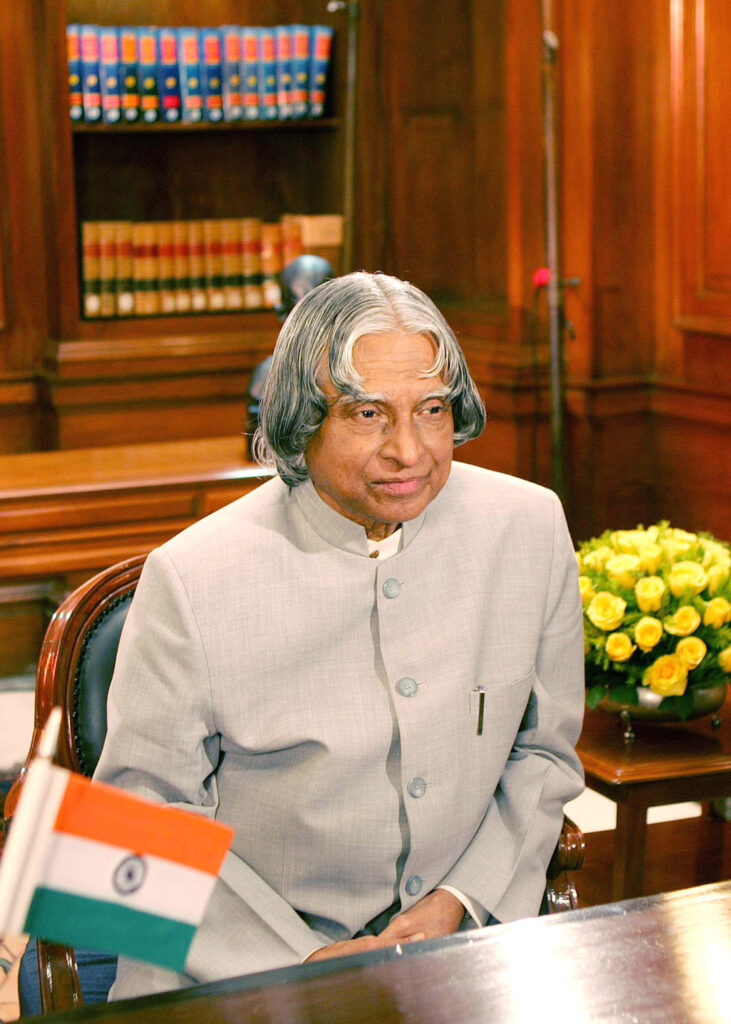
Dr. Avul Pakir Jainulabdeen Abdul Kalam, fondly remembered as the “Missile Man of India” and “People’s President,” was one of the most respected scientists and statesmen in modern Indian history. His life journey—from a small coastal town to the Rashtrapati Bhavan—stands as a powerful example of humility, perseverance, patriotism, and vision. Dr. Kalam was not only a brilliant aerospace scientist but also a deeply spiritual human being, an inspiring teacher, and a visionary leader who dedicated his entire life to the progress and development of India.
Born into a modest family, Abdul Kalam rose through sheer determination, hard work, and faith in education. He played a crucial role in India’s civilian space program and military missile development, making India self-reliant in critical defense technologies. As the 11th President of India, he earned immense public admiration for his simplicity, accessibility, and dedication to youth empowerment. Even after holding the highest constitutional office, he remained a lifelong student and teacher until his final breath.
This biography explores Dr. Kalam’s life in depth—his early years, education, scientific career, presidency, philosophy, books, awards, and lasting legacy.
Early Life and Family Background
Dr. A. P. J. Abdul Kalam was born on 15 October 1931 in Rameswaram, a small pilgrimage town on Pamban Island in the then Madras Presidency (now Tamil Nadu). Rameswaram is known for its spiritual significance and cultural harmony, which deeply influenced Kalam’s worldview from an early age.
His father, Jainulabdeen, was a boat owner and imam of a local mosque. Though he had little formal education, he was known for his wisdom, integrity, and spiritual discipline. Kalam’s mother, Ashiamma, was a kind and generous homemaker who often fed strangers and guests despite the family’s limited means. Abdul Kalam was the youngest of five siblings in a close-knit and disciplined household.
The Kalam family lived a simple life. Their home lacked many comforts, but it was rich in values such as honesty, compassion, hard work, and faith. From his parents, Kalam learned the importance of self-respect, prayer, tolerance, and service to others. His upbringing in a multi-religious society, where Hindus, Muslims, and Christians lived harmoniously, shaped his lifelong belief in unity and secularism.
Childhood Struggles and Early Influences
Abdul Kalam’s childhood was marked by financial hardship. During World War II, when resources were scarce, he supported his family by selling newspapers at the Rameswaram railway station. This experience instilled in him a strong work ethic and a sense of responsibility from a young age.
Despite economic challenges, Kalam was an eager learner. He was an average student academically but had an exceptional curiosity about the world around him. He was especially fascinated by birds and flight, often watching seagulls soar over the sea. This fascination later evolved into a deep interest in aeronautics and space science.
Several teachers played a pivotal role in shaping Kalam’s character and ambitions. One such teacher, Sivasubramania Iyer, introduced him to the wonders of science and encouraged him to dream big. Another teacher, Iyadurai Solomon, inspired Kalam to believe in his potential and taught him that faith and hard work together could overcome any obstacle.
Education and Academic Journey
After completing his primary education in Rameswaram, Kalam moved to Ramanathapuram for secondary schooling. He later enrolled at St. Joseph’s College, Tiruchirappalli, where he graduated in Physics in 1954. Although he enjoyed physics, he soon realized that his true passion lay in engineering and applied sciences.
In 1955, Kalam joined the Madras Institute of Technology (MIT) to study aerospace engineering. His time at MIT was transformative. He immersed himself in studies related to aircraft design and propulsion systems. Financial difficulties persisted, but Kalam remained focused and disciplined.
A defining moment came when Kalam missed a project deadline and faced the risk of losing his scholarship. The director of the institute gave him three days to complete the task. Working tirelessly, Kalam succeeded, learning a lifelong lesson about commitment, time management, and resilience.
Early Career and Entry into Scientific Research
After graduating from MIT in 1960, Abdul Kalam joined the Defense Research and Development Organisation (DRDO) as a scientist. His initial work involved designing a small hovercraft for the Indian Army. Although the project did not gain immediate success, it provided Kalam valuable experience in applied research.
In 1969, Kalam was transferred to the Indian Space Research Organisation (ISRO), where his career took a significant turn. At ISRO, he worked under the visionary leadership of Dr. Vikram Sarabhai, the father of India’s space program. Kalam found Sarabhai’s leadership style deeply inspiring and later adopted similar principles in his own work.
Role in India’s Space Program
At ISRO, Abdul Kalam served as the Project Director of the Satellite Launch Vehicle (SLV-III). This project aimed to develop India’s capability to launch satellites independently. The initial launch in 1979 failed, resulting in widespread disappointment. Kalam, as project leader, took full responsibility for the failure.
However, his leadership shone through during adversity. He motivated his team, analyzed mistakes, and prepared for a renewed attempt. In 1980, the SLV-III successfully placed the Rohini satellite into orbit, marking a historic milestone for India’s space program.
This success established Kalam as a capable leader and brilliant scientist. It also demonstrated his belief that failure is a stepping stone to success—an idea he later emphasized repeatedly in his speeches and writings.
Missile Man of India
In the early 1980s, Abdul Kalam returned to DRDO, where he led India’s Integrated Guided Missile Development Programme (IGMDP). Under his leadership, India developed a series of strategic missiles, including Agni, Prithvi, Akash, Trishul, and Nag.
These achievements earned Kalam the title “Missile Man of India.” His work significantly strengthened India’s defense capabilities and contributed to national security and technological self-reliance. Despite the military nature of his work, Kalam consistently emphasized that technology should be used for peace and development.
Kalam played a key role in India’s Pokhran-II nuclear tests in 1998, serving as Chief Scientific Adviser to the Prime Minister. The successful tests placed India among the world’s nuclear powers. Yet, Kalam maintained a balanced perspective, advocating global nuclear disarmament and ethical scientific progress.
APJ Abdul Kalam Networth
Presidency of India (2002–2007)
In 2002, Abdul Kalam was elected as the 11th President of India, with overwhelming support across political parties. His election was historic, as he was a scientist and teacher rather than a career politician.
As President, Kalam redefined the role of the head of state. He was accessible, humble, and deeply connected with the people, especially students. He frequently visited schools and universities, encouraging young Indians to dream big and work hard.
He introduced the concept of “India 2020,” a vision to transform India into a developed nation through education, technology, healthcare, and sustainable development. Kalam believed that the youth were the driving force behind national transformation.
Despite his popularity, Kalam exercised his constitutional duties with integrity and independence. He carefully reviewed legislation and occasionally returned bills for reconsideration, demonstrating his commitment to democratic values.
Life After Presidency
After completing his term in 2007, Abdul Kalam chose not to seek re-election. Instead, he returned to his passion for teaching and mentoring. He became a visiting professor at several prestigious institutions, including IIM Shillong, IIM Ahmedabad, and Anna University.
Kalam continued to write, speak, and interact with students across the country. He remained deeply engaged in discussions on education reform, innovation, and national development. Despite health issues, he maintained a demanding schedule, driven by his love for learning and teaching.
Books and Literary Contributions
Dr. Kalam was a prolific writer. His books reflect his life experiences, scientific vision, and philosophical insights. Some of his most notable works include:
- “Wings of Fire” – An autobiography detailing his early life and scientific journey
- “Ignited Minds” – A call to awaken the potential of India’s youth
- “India 2020” – A strategic vision for national development
- “Turning Points” – A sequel to his autobiography
- “My Journey” – Reflections on life lessons
These books are widely read and studied, inspiring millions to pursue excellence and serve the nation.
Awards and Honors
Dr. Kalam received numerous awards and honors throughout his life, including:
- Padma Bhushan (1981)
- Padma Vibhushan (1990)
- Bharat Ratna (1997) – India’s highest civilian award
He also received honorary doctorates from over 40 universities worldwide and was recognized globally for his contributions to science and education.
Personal Life and Philosophy
Abdul Kalam remained a bachelor throughout his life. He lived simply, owned few possessions, and followed a disciplined routine of reading, writing, prayer, and reflection. He was deeply spiritual and believed in the harmony of science and religion.
Kalam often spoke about the importance of values such as integrity, humility, perseverance, and compassion. He believed that true success lies not in personal gain but in contributing to the welfare of society.
Death and Legacy
On 27 July 2015, Dr. A. P. J. Abdul Kalam collapsed while delivering a lecture at IIM Shillong. He passed away doing what he loved most—teaching students. His death was mourned across India and the world.
Dr. Kalam’s legacy lives on through his writings, speeches, institutions, and, most importantly, the millions of young minds he inspired. He remains a symbol of what dedication, education, and moral leadership can achieve.
Conclusion
Dr. A. P. J. Abdul Kalam’s life is a story of dreams realized through discipline, humility, and service. From a newspaper-selling boy in Rameswaram to the President of India, his journey exemplifies the power of education and perseverance. He proved that greatness is not defined by wealth or power, but by character and contribution.
Even today, Abdul Kalam continues to inspire generations to dream big, think differently, and work tirelessly for a better India and a better world.