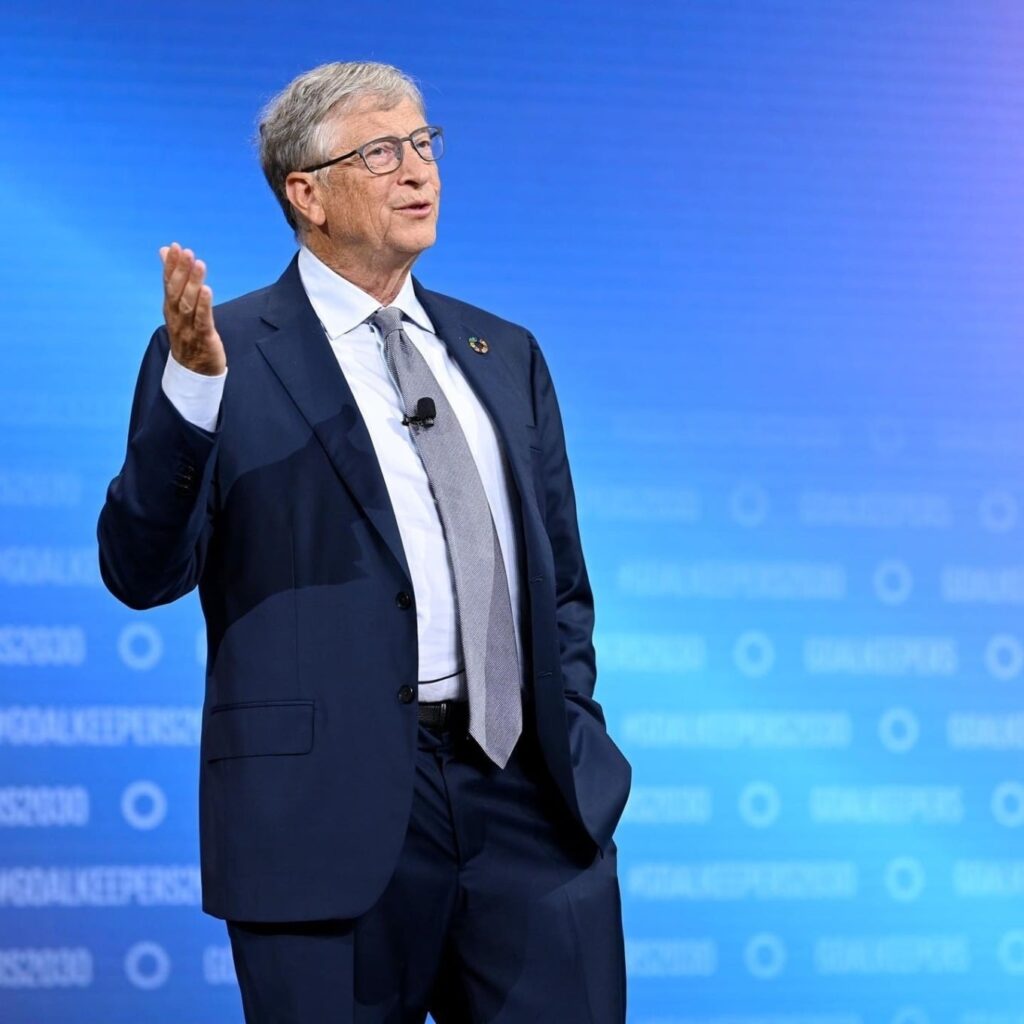
Bill Gates is an American entrepreneur, software developer, and philanthropist. He co-founded Microsoft, helping launch the personal computer revolution. For decades he ranked among the world’s richest people. Through the Bill & Melinda Gates Foundation, he focuses on global health, education, and poverty reduction. He advocates for climate innovation worldwide.
Introduction :
William Henry Gates III, widely known as Bill Gates, is one of the most influential figures in modern history. As the co-founder of Microsoft Corporation, Gates played a central role in the personal computer revolution that transformed how people work, communicate, and live. His vision of placing “a computer on every desk and in every home” helped shape the digital age. Beyond his achievements in technology and business, Gates has become equally renowned for his philanthropic work through the Bill & Melinda Gates Foundation, one of the largest charitable organizations in the world.
This biography explores Bill Gates’s life in detail—from his early childhood and education, through the rise of Microsoft, to his later transition into global philanthropy—highlighting the personal qualities, decisions, and historical circumstances that shaped his extraordinary journey.
Early Life and Family Background
Bill Gates was born on October 28, 1955, in Seattle, Washington, USA. He was the second of three children born to William H. Gates Sr., a prominent lawyer, and Mary Maxwell Gates, a schoolteacher, businesswoman, and civic leader. His family environment was intellectually stimulating and achievement-oriented, with a strong emphasis on education, discipline, and public service.
Mary Gates served on the boards of several major organizations, including United Way and IBM-related committees. Her professional connections and leadership skills later played a subtle but significant role in Gates’s early business opportunities. Bill Gates grew up in a competitive household where discussions about current events, logic, and problem-solving were common.
From an early age, Gates showed signs of exceptional intelligence, curiosity, and determination. His parents noticed that he had a tendency to become deeply focused on tasks that interested him, sometimes to the point of obsession. Although this trait occasionally caused conflicts at home, it would later become one of his greatest strengths.
Early Education and Discovery of Computers
Bill Gates attended Lakeside School, a private preparatory school in Seattle. It was here, at the age of 13, that his life took a decisive turn. In 1968, Lakeside acquired a Teletype Model 33 ASR terminal, connected to a General Electric computer. At a time when computers were rare and expensive, this opportunity was extraordinary.
Gates quickly became fascinated by computers and programming. He taught himself BASIC programming language and spent countless hours experimenting, debugging, and writing code. Along with his close friend Paul Allen, Gates began developing software programs, often skipping other school activities to gain more computer time.
The group of students, including Gates, Allen, Ric Weiland, and Kent Evans, formed the Lakeside Programmers Group. They were so absorbed in programming that they were sometimes banned from using the school computer for excessive use. Undeterred, Gates and Allen found other ways to access computers, including working for companies in exchange for computing time.
Early Programming Ventures
One of Gates’s earliest entrepreneurial ventures occurred when he was still a teenager. At age 15, Gates and Allen developed a traffic-counting system for the city of Seattle, earning around $20,000. This experience introduced Gates to the idea that software could be commercially valuable.
Later, Gates and Allen founded a small company called Traf-O-Data, which aimed to analyze traffic data using microprocessors. Although Traf-O-Data was not commercially successful, it provided valuable business and technical experience and laid the groundwork for their future endeavors.
The sudden death of Gates’s friend Kent Evans in a mountaineering accident deeply affected him. Gates channeled his emotions into his work, becoming even more focused on programming and long-term ambitions.
Harvard University and a Defining Decision
In 1973, Bill Gates enrolled at Harvard University, where he studied mathematics and computer science. Although he was an exceptional student, Gates found traditional academic life restrictive. He spent more time in the computer lab than in lectures and often stayed awake all night programming.
At Harvard, Gates met Steve Ballmer, who would later become Microsoft’s CEO. Their complementary personalities—Gates’s technical brilliance and Ballmer’s business acumen—formed a powerful partnership.
The turning point came in 1975, when Paul Allen showed Gates an article about the Altair 8800, one of the first personal computers. Recognizing the enormous potential of personal computing, Gates and Allen contacted the manufacturer, MITS, and claimed they had developed a version of BASIC for the Altair—despite not having completed it yet.
Working intensely, Gates and Allen successfully created the software. This moment marked the beginning of a revolution. Gates soon made the bold decision to drop out of Harvard, believing that the opportunity before him was too important to ignore.
Founding of Microsoft
In 1975, Gates and Allen founded a company initially called Micro-Soft (a combination of “microcomputer” and “software”), which later became Microsoft Corporation. Gates was just 19 years old.
From the beginning, Gates demonstrated a sharp business sense. He insisted on licensing software rather than selling it outright, allowing Microsoft to retain control and profit repeatedly from its products. This strategy would later prove decisive in Microsoft’s dominance of the software industry.
Gates also held strong views on intellectual property. In 1976, he wrote the famous “Open Letter to Hobbyists”, arguing that software should be paid for and that piracy undermined innovation. This stance was controversial at the time but became foundational to the modern software business model.
Rise of Microsoft And the PC Revolution
The defining moment in Microsoft’s history came in 1980, when IBM approached the company to provide an operating system for its upcoming personal computer. Microsoft did not yet have an operating system, but Gates seized the opportunity.
Microsoft acquired an existing system called QDOS (Quick and Dirty Operating System), modified it, and licensed it to IBM as MS-DOS. Crucially, Gates negotiated a deal that allowed Microsoft to retain ownership of MS-DOS and license it to other hardware manufacturers.
This decision led to Microsoft’s explosive growth. As IBM-compatible PCs flooded the market, MS-DOS became the standard operating system, establishing Microsoft as a dominant force in the tech industry.
Windows and Global Dominance
In 1985, Microsoft launched Windows, a graphical user interface built on top of MS-DOS. Although early versions were limited, Windows gradually evolved into a powerful operating system that made computers accessible to non-technical users.
The release of Windows 3.0 in 1990 was a major success, followed by Windows 95, which transformed personal computing. Microsoft Office, including Word, Excel, and PowerPoint, became the dominant productivity suite worldwide.
By the mid-1990s, Bill Gates was the richest person in the world, a position he held for many years. His leadership style was famously intense; he demanded excellence, encouraged debate, and personally reviewed large amounts of code even as CEO.
Bill Gates Networth
Leadership Style and Personality
Bill Gates was known for his analytical thinking, competitive nature, and relentless work ethic. He was deeply involved in technical decisions and expected employees to defend their ideas rigorously. While some critics described him as intimidating, others admired his intellect and commitment to innovation.
Gates was also a voracious reader, known for consuming dozens of books each year on subjects ranging from science and history to economics and global health. This habit would later influence his philanthropic approach.
Antitrust Controversies and Legal Challenges
Microsoft’s dominance attracted intense scrutiny. In the late 1990s, the U.S. Department of Justice filed an antitrust lawsuit against Microsoft, accusing the company of abusing its monopoly power by bundling Internet Explorer with Windows.
The legal battle was long and complex. Although a court initially ordered Microsoft to be broken up, the decision was later overturned on appeal. Microsoft ultimately reached a settlement that imposed restrictions on its business practices.
The case marked a turning point for Gates, prompting him to reflect on leadership, responsibility, and the broader impact of corporate power.
Transition from Microsoft Leadership
In 2000, Gates stepped down as CEO of Microsoft, becoming Chief Software Architect, while Steve Ballmer assumed the role of CEO. Over the next several years, Gates gradually reduced his involvement in daily operations.
In 2008, Gates officially left his full-time role at Microsoft to focus on philanthropy. Although he remained an advisor and board member, his primary mission shifted toward addressing global challenges.
The Bill & Melinda Gates Foundation
Founded in 2000, the Bill & Melinda Gates Foundation became the world’s largest private charitable foundation. Its mission focuses on improving global health, reducing poverty, expanding educational opportunities, and addressing climate change.
The foundation has invested billions of dollars in initiatives such as:
- Eradicating polio and malaria
- Improving access to vaccines
- Supporting education reform
- Advancing agricultural development in poor regions
Gates applied the same data-driven, analytical approach to philanthropy that he used in business, emphasizing measurable outcomes and long-term impact.
Personal Life
Bill Gates married Melinda French in 1994. Together, they had three children: Jennifer, Rory, and Phoebe. The family emphasized education, humility, and social responsibility.
In 2021, Bill and Melinda Gates announced their divorce after 27 years of marriage. Despite the separation, they committed to continuing their philanthropic work together.
Views on Global Challenges
In recent years, Gates has become a prominent voice on issues such as:
- Climate change
- Global pandemics
- Artificial intelligence
- Sustainable energy
He has warned about the risks of unpreparedness for pandemics and advocated for global cooperation, scientific research, and innovation-driven solutions.

Legacy and Influence
Bill Gates’s legacy is multifaceted. As a technologist, he helped launch the personal computing era. As a businessman, he built one of the most successful companies in history. As a philanthropist, he redefined how private wealth can be used to address global problems.
While critics continue to debate his influence and methods, few dispute his profound impact on the modern world. Gates remains a symbol of innovation, ambition, and the power of ideas.
Conclusion
The life of Bill Gates illustrates how intellect, opportunity, persistence, and vision can converge to change the world. From a curious teenager programming computers in a school lab to a global leader shaping technology and philanthropy, Gates’s journey reflects the transformative potential of human creativity.
His story continues to evolve, but his contributions—to computing, business, and global welfare—have already secured his place among the most important figures of the modern era.
Bill Gates Birthday Date ?
28 Oct 1955
Bill Gates Doughter Name ?
Jennifer Gates And Phoebe Gates
Bill Gates Networth ?
$115.1 billion