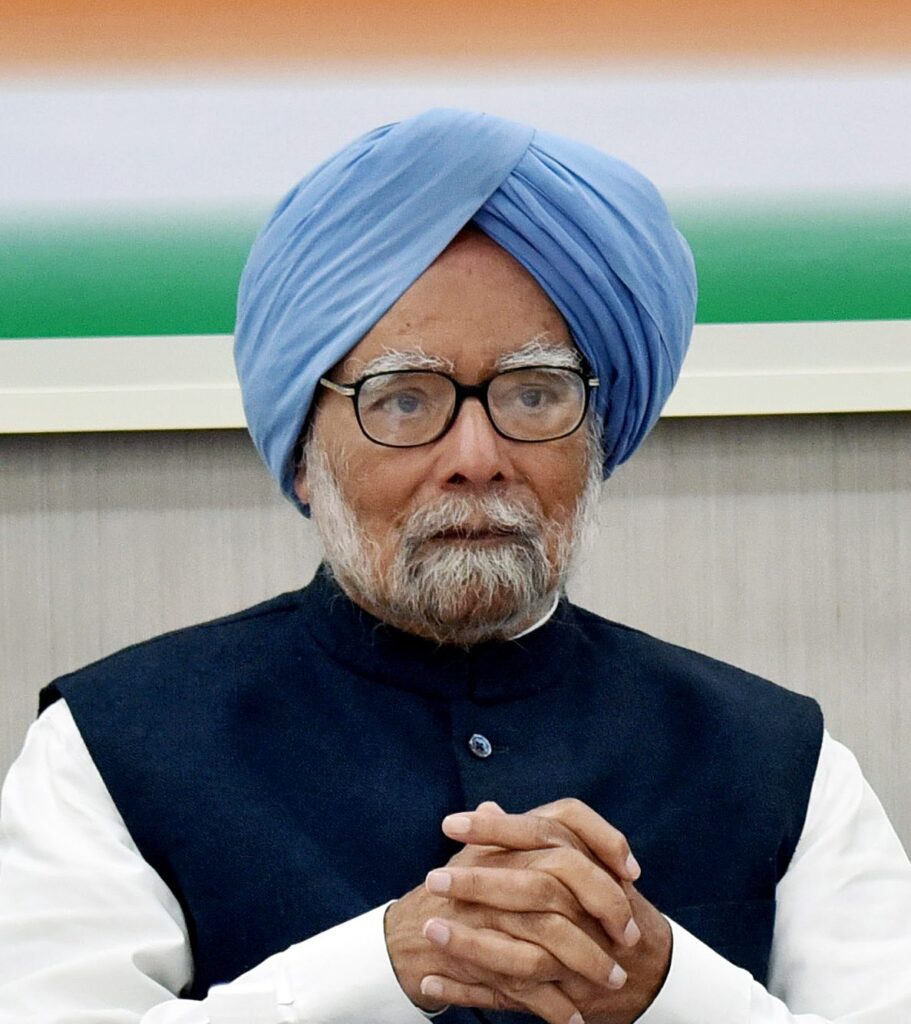
Manmohan Singh (1932–2024) was an Indian economist and statesman who served as India’s Prime Minister from 2004 to 2014. A key architect of India’s 1991 economic liberalization as Finance Minister under P. V. Narasimha Rao, he strengthened economic growth and global ties during his tenure.
Introduction
Dr. Manmohan Singh is one of the most respected economists and political leaders in modern Indian history. Known for his humility, integrity, and intellectual depth, he played a pivotal role in transforming India’s economy and guiding the country through a crucial phase of globalization and development. Serving as the 13th Prime Minister of India from 2004 to 2014, he was the first Sikh to hold the office and the first prime minister since Jawaharlal Nehru to be re-elected after completing a full five-year term. His contributions to economic reforms, foreign policy, and social welfare programs have left a lasting imprint on India’s political and economic landscape.
This biography explores his early life, education, academic career, role as an economist, tenure as Finance Minister, and decade-long leadership as Prime Minister, along with his legacy and personal values.
Early Life and Background
Manmohan Singh was born on September 26, 1932, in Gah, a small village in Punjab (now in Pakistan). At the time of his birth, India was under British colonial rule. He was born into a modest Sikh family. His father, Gurmukh Singh, was a small trader, and his mother, Amrit Kaur, passed away when he was very young. Raised primarily by his grandmother, Singh grew up in an environment that valued education and discipline.
The partition of India in 1947 had a profound impact on his life. Like millions of others, his family migrated from what became Pakistan to India during the violent upheaval of Partition. They resettled in Amritsar, Punjab. The experience of displacement and hardship deeply influenced his worldview and strengthened his resolve to pursue education as a means of stability and progress.
Education and Academic Excellence
Manmohan Singh was an exceptionally bright student. He completed his matriculation from Punjab University in 1948. He then earned a Bachelor’s degree in Economics from Punjab University in 1952 and a Master’s degree in Economics in 1954, graduating at the top of his class.
His academic excellence earned him a scholarship to study at the University of Cambridge in the United Kingdom. At Cambridge, he attended St John’s College and completed his Economics Tripos in 1957 with first-class honors. He later pursued a D.Phil. (Doctor of Philosophy) at the University of Oxford, specifically at Nuffield College, completing his doctoral thesis in 1962. His thesis focused on India’s export performance, reflecting his early interest in economic policy and development.
His years abroad exposed him to global economic theories and policymaking frameworks, which would later shape his approach to economic reforms in India.
Academic and Bureaucratic Career
After completing his studies, Manmohan Singh began his career in academia. He served as a professor at Punjab University and later at the Delhi School of Economics. His reputation as a brilliant economist grew steadily.
In the 1970s and 1980s, Singh transitioned into government service. He held several key positions, including:
- Chief Economic Adviser (1972–1976)
- Secretary in the Ministry of Finance
- Governor of the Reserve Bank of India (1982–1985)
- Deputy Chairman of the Planning Commission (1985–1987)
- Advisor to the Prime Minister on Economic Affairs
As Governor of the Reserve Bank of India, he played a key role in monetary policy during a challenging economic period. His expertise and calm demeanor earned him widespread respect among policymakers and economists.
Manmohan Singh Networth :
Finance Minister and the 1991 Economic Reforms
One of the defining moments of Manmohan Singh’s career came in 1991. India was facing a severe balance-of-payments crisis. Foreign exchange reserves had fallen to dangerously low levels, and the country was on the brink of default.
In June 1991, Prime Minister P. V. Narasimha Rao appointed Manmohan Singh as Finance Minister. Though not a career politician, Singh accepted the challenge.
He introduced a series of groundbreaking economic reforms that fundamentally transformed India’s economy. These reforms included:
- Liberalization of trade policies
- Reduction of import tariffs
- Deregulation of industries
- Devaluation of the rupee
- Encouragement of foreign investment
- Privatization of certain public sector enterprises
In his historic budget speech, he quoted Victor Hugo: “No power on earth can stop an idea whose time has come.” This marked the beginning of India’s shift from a closed, state-controlled economy to a more open and market-oriented system.
The 1991 reforms laid the foundation for India’s rapid economic growth in the following decades. They are widely regarded as a turning point in the nation’s economic history.
Political Journey and Rise to Prime Minister
Although he was not known as a mass political leader, Manmohan Singh gradually became a central figure in Indian politics. He was a member of the Rajya Sabha (Upper House of Parliament) for many years, representing the state of Assam.
After the 2004 general elections, the Indian National Congress, led by Sonia Gandhi, emerged as the largest party in a coalition known as the United Progressive Alliance (UPA). Despite being widely expected to become Prime Minister, Sonia Gandhi declined the post and nominated Manmohan Singh.
On May 22, 2004, Manmohan Singh was sworn in as the Prime Minister of India.
First Term as Prime Minister (2004–2009)
During his first term, India experienced strong economic growth, with GDP growth rates averaging around 8–9%. His government focused on inclusive development and social welfare programs.
Major initiatives included:
- National Rural Employment Guarantee Act (NREGA), which guaranteed rural employment
- Right to Information Act (RTI), enhancing transparency
- Expansion of education and healthcare schemes
- Strengthening infrastructure development
One of the most significant foreign policy achievements of his tenure was the India–US Civil Nuclear Agreement. This landmark deal, negotiated with U.S. President George W. Bush, allowed India access to civilian nuclear technology despite not being a signatory to the Nuclear Non-Proliferation Treaty (NPT). The agreement marked a new era in India–US relations.
Second Term as Prime Minister (2009–2014)
In 2009, the UPA won re-election, and Manmohan Singh began his second term. However, this period was more challenging.
Although the government implemented important policies such as:
- The Right to Education Act
- Food Security Act
- Expansion of Aadhaar (unique identity system)
It also faced several controversies and corruption scandals, including the 2G spectrum case and the Commonwealth Games controversy. These issues led to criticism of the government and damaged its public image.
Economic growth slowed during his second term due to global financial instability and domestic challenges. Critics questioned his leadership style, often describing him as soft-spoken and reserved. However, supporters argued that his integrity and steady approach were strengths in a complex coalition government.
Leadership Style and Personality
Manmohan Singh is widely known for his simplicity and honesty. Unlike many politicians, he maintained a low profile and avoided aggressive rhetoric. He was often described as a “reluctant politician” who preferred policy work over political maneuvering.
His calm demeanor, soft-spoken nature, and scholarly background set him apart from many of his contemporaries. Despite facing political attacks and public criticism, he rarely responded with personal attacks.
He was known for his famous statement during a difficult period: “History will be kinder to me than the contemporary media.”
Relationship with Other Leaders
Throughout his career, Singh worked closely with many prominent political figures. His professional relationship with P. V. Narasimha Rao during the 1991 reforms was crucial to India’s economic transformation.
During his prime ministership, he coordinated with Sonia Gandhi, who remained Congress party president. This dual leadership structure was sometimes criticized by opponents but helped maintain coalition stability.
He also interacted extensively with global leaders, including U.S. President George W. Bush, UK Prime Ministers, and leaders of neighboring countries such as Pakistan and China. His tenure saw improved ties with the United States and strengthened engagement with global economic institutions.
Awards and Recognition
Manmohan Singh has received numerous awards and honors for his academic and public service contributions. These include honorary degrees from prestigious universities and recognition for his role in economic reforms.
In 1987, he was awarded the Padma Vibhushan, India’s second-highest civilian award, for his service in civil service and public affairs.
He has been consistently regarded as one of the most educated and intellectually accomplished leaders in Indian politics.

Legacy
Manmohan Singh’s legacy is closely tied to the 1991 economic reforms and India’s rise as a global economic power. The liberalization policies he initiated as Finance Minister reshaped India’s economic destiny.
As Prime Minister, he oversaw a decade of significant growth, expanded social welfare programs, and strengthened India’s global position. While his second term faced criticism due to corruption scandals and economic slowdown, his personal integrity remained largely unquestioned.
He is often remembered as a leader who prioritized policy over politics, governance over rhetoric, and long-term national interest over short-term popularity.
Conclusion
Dr. Manmohan Singh’s life story is one of resilience, scholarship, and public service. From a small village in pre-Partition Punjab to the highest office in the world’s largest democracy, his journey reflects the power of education, dedication, and integrity.
As an economist, he helped rescue India from economic crisis and opened its doors to global markets. As Prime Minister, he guided the nation through growth and globalization while emphasizing inclusive development.
Whether praised for his reforms or criticized for political challenges during his tenure, Manmohan Singh remains a towering figure in Indian public life. His quiet determination, intellectual brilliance, and commitment to public service have secured him a lasting place in India’s history.
Manmohan Singh DOB ?
26 September 1932
Manmohan Singh Networth ?
Manmohan Singh’s declared net worth was approximately ₹15 crore to over ₹15.77 crore,
Manmohan Singh Reason Of Death ?
after suffering a sudden loss of consciousness at home and being treated for age-related medical conditions, according to official statements.