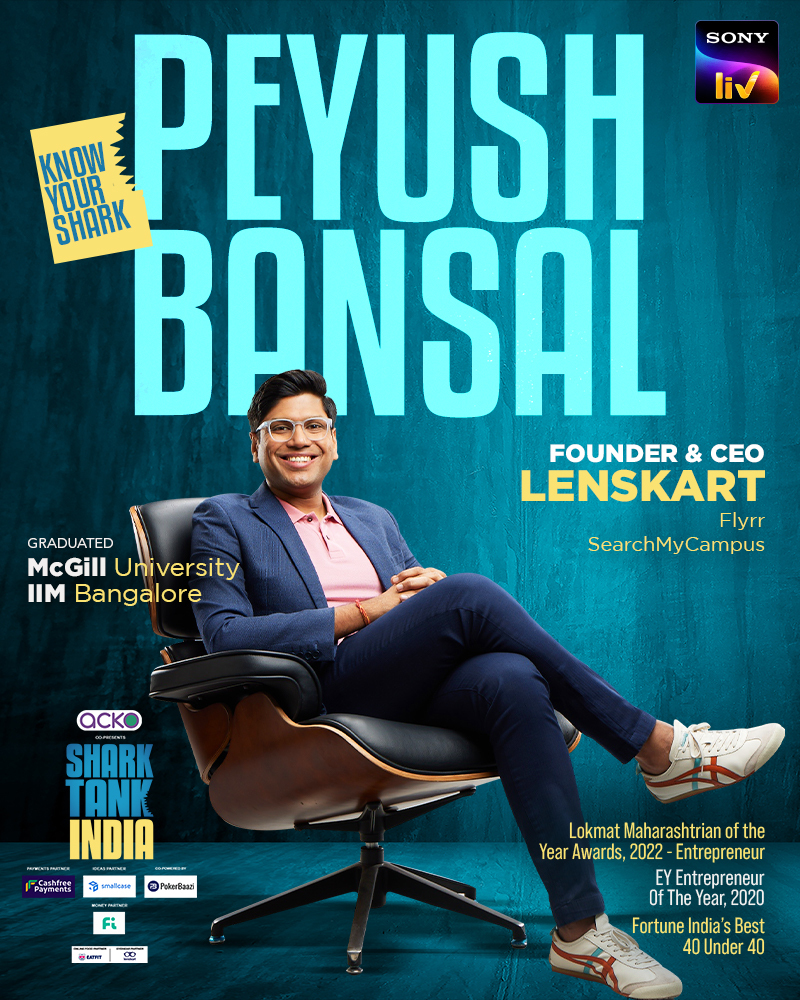
Peyush Bansal is an Indian entrepreneur, investor, and co-founder of Lenskart, India’s leading eyewear brand. An IIT Delhi and IIM Bangalore alumnus, he is known for innovation, consumer focus, and as a judge on Shark Tank India, inspiring startups with practical advice and vision through leadership, execution, and long-term value.
Introduction :
Peyush Bansal is a renowned Indian entrepreneur and the co-founder and CEO of Lenskart, one of India’s largest and most successful eyewear companies. Born in 1985, he completed his education at IIT Delhi, where he earned a degree in Electrical Engineering. He later worked at Microsoft in the United States before returning to India to pursue entrepreneurship. Peyush founded Lenskart with the vision of making quality eyewear affordable and accessible to everyone through technology and innovation. Under his leadership, Lenskart has grown into a global brand with a strong omnichannel presence.
Early Life and Family Background
Peyush Bansal was born on 26 April 1985 in New Delhi, India, into a Hindu Bansal family to parents Bal Kishan and Kiran Bansal. He grew up with typical middle-class aspirations but was exposed early to technology and academics, which shaped his future. His schooling was at Don Bosco School, New Delhi, where he developed fundamental interests in computers and problem-solving.
From childhood, Peyush exhibited a combination of academic ability and curiosity about technology. He later pursued higher education at McGill University in Montreal, Canada, where he completed a Bachelor of Electrical Engineering (specializing in IT, Control & Automation). During his time at McGill, he worked part-time as a receptionist and engaged with coding and computing — experiences that ignited his early interest in digital platforms and entrepreneurship.
The Start of a Career: Microsoft and Return to India
After graduating from McGill University in the mid-2000s, Peyush launched into the professional world by joining Microsoft in the United States as a Program Manager in early 2007. This role offered him real exposure to software product management, enterprise processes, and global business practices. However, despite the prestige and stability of his tech role, Bansal felt an increasing pull towards building something of his own — something that could make a real impact.
In December 2007, after a short but formative year at Microsoft, Peyush made a pivotal decision: he resigned and returned to India with the goal of becoming an entrepreneur. This return set the stage for his entry into the startup ecosystem, which at the time was nascent in India.
First Ventures: Search My Campus and Valyoo Technologies
On returning to India in 2007–2008, Peyush founded one of his earliest ventures, SearchMyCampus.com — an online classifieds platform aimed at Indian college students. The portal aimed to provide solutions to real campus-related issues like housing, jobs, transportation, books, and internships — bridging an information gap for students that was largely underserved by the market. Though it wasn’t a runaway success, the venture gave Bansal his first taste of building and running a digital startup in India, and valuable lessons in operations, customer behavior, and product design.
During this period, Peyush also registered Valyoo Technologies in June 2008 — an umbrella company that would become a launchpad for multiple online ventures. He registered it from his parents’ home in Greater Kailash, alongside a small team of early employees.
Under Valyoo Technologies, Bansal experimented with several e-commerce businesses. These included Flyrr (an eyewear platform aimed at the US market), WatchKart, JewelsKart, and BagsKart — attempting to replicate the marketplace model prevalent among global e-commerce startups. However, these ventures either underperformed or operated on thin margins. Bansal’s early experiences taught him about market dynamics, the importance of focus, and the difficulties of scaling online businesses without a clear value proposition.
Founding Lenskart: Vision and Strategy
In late 2010, Peyush Bansal, along with Amit Chaudhary, launched Lenskart — an eyewear-focused e-commerce company aimed at making quality eyeglasses and eyewear affordable and accessible to Indians. Sumeet Kapahi joined as a co-founder in 2011, bringing industry expertise and operational strength to the team.
What set Lenskart apart from traditional eyewear outlets was its hybrid online-plus-offline model, smart use of technology, and a laser focus on disrupting a largely unorganized market. Initially selling primarily contact lenses online, the company expanded into eyeglasses and sunglasses, building a full suite of eyewear offerings. Soon, its network of home eye tests, virtual try-ons, and omni-channel retail presence created what Bansal envisioned: a seamless, customer-centric eyewear shopping experience.
Rather than simply copying Western e-commerce models, Peyush chose to tailor the company’s strategy to Indian consumer insights — merging digital convenience with physical touchpoints. This approach helped Lenskart penetrate deeper into smaller cities and towns where customers still valued offline interactions.
Growth, Expansion, And Scaling
Under Peyush’s leadership, Lenskart transformed from a small online eyewear startup into India’s largest eyewear brand, disrupting an industry that had long been dominated by traditional optical shops. By the mid-2010s, Lenskart was an omnichannel brand with hundreds of retail stores, a thriving online presence, advanced technology like virtual try-ons and home eye exams, and a business model that efficiently combined inventory control with customer convenience.
Some major milestones in this journey included:
- Rapid store expansion into tier-II and tier-III cities across India, making eyewear accessible nationwide.
- Lenskart becoming a unicorn in 2020, crossing a valuation of over $1.5 billion — a landmark achievement for an Indian direct-to-consumer (D2C) brand.
- Global expansion into markets like Southeast Asia, the Middle East, Japan, and the United States, signaling that Lenskart’s model was scalable beyond India.
- Strategic acquisitions, including a majority stake in Japanese eyewear brand Owndays, helping Lenskart grow its international footprint.
- Securing significant funding rounds, such as a USD 500 million investment from Abu Dhabi Investment Authority (ADIA) for about 10% equity — a testament to investor confidence and strong revenue performance.
IPO and Corporate Leadership
A crucial moment in Lenskart’s journey — and Peyush’s career — came in 2025, when the company moved toward becoming a publicly traded entity. The firm filed draft red herring prospectus (DRHP) documents with the Securities and Exchange Board of India (SEBI) and prepared for a large initial public offering (IPO) — a milestone that would validate years of steady growth, operational scaling, and strategic vision.
In November 2025, Lenskart’s IPO raised over ₹7,278 crore (~$870 million) and saw overwhelming investor demand. Shares were subscribed multiple times over, signaling tremendous market interest. Ahead of the listing, Peyush shared an emotional reflection on Lenskart’s journey from a small online eyewear venture to a global omnichannel brand with significant valuations.
In addition to steering major funding and scaling efforts, Peyush also made strategic moves such as buying back stakes from investors like SoftBank and Chiratae Ventures, underscoring his confidence in the company’s long-term potential.
Leadership Style and Business Philosophy
Peyush Bansal’s leadership is defined by focus, customer obsession, long-term thinking, and innovation. He often emphasizes the importance of solving real problems with scalable technology rather than chasing short-term valuation peaks or hype. His commentary at industry events highlights a belief that startups should build sustainable businesses backed by solid fundamentals — not just high valuations.
He is known for his frugal financial philosophy, where profit and cash flow optimization take precedence over flamboyant spending. Bansal has reportedly preferred reinvesting in the business and technology rather than lavish personal expenditures, reinforcing a founder’s mindset centered on purpose over flash.
Role as an Investor: Shark Tank India
Beyond Lenskart, Peyush became widely known as one of the judges and investors on Shark Tank India — a prime-time business reality show that debuted in 2021 and brought startup investment into mainstream Indian culture.
On the show, Peyush evaluates hundreds of business pitches, providing mentorship, capital, and strategic advice to aspiring entrepreneurs across sectors like consumer tech, consumer goods, edtech, health, and more. His investment style on the show reflects his belief in purpose-driven ventures, strong product-market fit, and founders with resolve and clarity.
His role on Shark Tank India elevated his public persona — connecting him with millions of viewers, especially young entrepreneurs and business aspirants. It also reinforced his standing as an active participant in India’s startup ecosystem, beyond his own company’s growth.
Investments, Mentorship, and Startup Ecosystem Contributions
Peyush’s involvement in startups extends beyond Shark Tank India. Through his investment activities, he has backed and mentored various startups — from lifestyle brands to technology solutions. Notable areas of support include companies like DailyObjects, Feedo, and others across lifestyle and consumer segments.
These investments reflect his interest in founders who solve meaningful problems at scale, and his mentorship often focuses on product development, market strategy, branding, and operational efficiency. His influence has encouraged a generation of Indian founders to think big while grounding their businesses in real consumer needs.
Public Recognition and Accolades
Over the years, Peyush Bansal has received multiple industry recognitions:
- Fortune India “40 Under 40” — acknowledging his leadership among India’s young business trailblazers.
- Red Herring Top 100 Asia Award — for innovation and entrepreneurship.
- Ernst & Young Entrepreneur of the Year (2020) — highlighting his leadership and business performance.
- Various startup and business awards celebrating Lenskart’s growth and disruptive impact.
These recognitions underscore his influence in shaping India’s D2C and retail technology landscape.
Personal Life and Values
Peyush Bansal maintains a relatively private personal life, preferring to keep the spotlight on his work and impact rather than personal details. He is married to Nimisha (or Nidhi/Mittal in some records), and the couple has a son.
Outside of business, Peyush enjoys reading, traveling, and exploring new ideas — interests that align with his continuous learning and innovation mindset. He often speaks about the importance of purpose, resilience, and meaningful impact in both business and personal life.
Challenges, Controversies, and Criticism
As with many high-profile entrepreneurs, Peyush and Lenskart have faced criticism and challenges:
- Operational and product quality complaints from some consumers circulating on social media and forums. These typically revolve around durability or customer service experiences, reflecting broader customer experience challenges in a business as large as Lenskart.
- Allegations regarding work culture or leadership expectations in internal teams, which sometimes surface on public forums as employee complaints.
- IPO valuation debates and franchisee disputes, discussed in investor communities and social media, pointing to the broader challenges of rapid scaling in an emerging public market.
While these do not define his career, they illustrate the complex realities of building and managing high-growth companies in diverse markets.

Legacy and Impact
At this stage of his career, Peyush Bansal stands as a defining figure in India’s entrepreneurial landscape — a founder who moved beyond first-mover advantages to build a sustainable, scalable business that combines technology with customer outreach. His story is a reference point for founders in e-commerce, retail, and tech-enabled businesses.
Lenskart’s transformation under his leadership — from a disruptive startup to a multi-national eyewear company with a successful IPO — demonstrates the power of vision, iteration, and perseverance. Bansal’s commitment to innovation, mentorship, impact investing, and building customer-centric businesses serves as a blueprint for the next generation of Indian entrepreneurs.
Conclusion
Peyush Bansal’s journey is a powerful testament to the impact of vision, perseverance, and purpose-driven entrepreneurship. From his early days as a technology student and Microsoft employee to becoming the founder and face of one of India’s most successful consumer brands, his story reflects the evolution of the Indian startup ecosystem itself. Rather than chasing quick success or fleeting valuations, Bansal focused on solving a real, everyday problem making quality eyewear accessible, affordable, and trustworthy for millions of people.
Peyush Bansal Date Of Birth ?
26 April 1985
Peyush Bansal Networth ?
$8 billion before its IPO in late 2025
Peyush Bansal Co-Founder Of ?
Co-founder and CEO of Lenskart